 By Marco Hugo Barsotti MHB
Welcome to am1575news, the news bulletin of France24 and Radio Centrale Milano for Monday 05 October 2026 in podcasting, on the medium wave and on franciaoggi.com. In the newsroom in Nice Marco Hugo Barsotti, from Paris Rachel Costa.
News from France
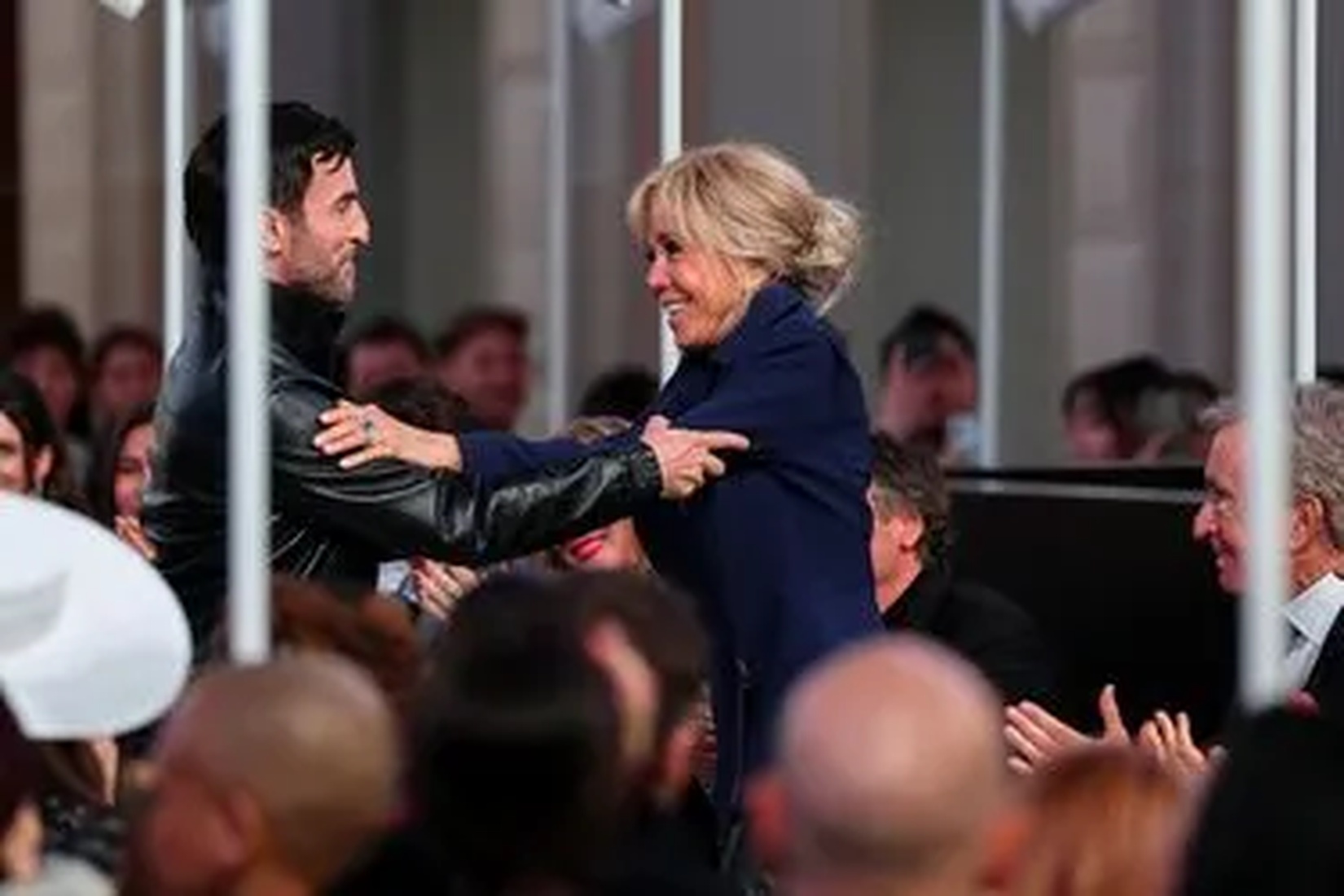
Brigitte Macron and fashion stars at the Élysée to celebrate Louis Vuitton
In the context of Paris Fashion Week, the Élysée Palace turned on Friday 2 October into a true temple of elegance. President Emmanuel Macron presented Nicolas Ghesquière, artistic director of Louis Vuitton’s women’s line, with the Knight of the Legion of Honour insignia, recognizing more than thirty years of an extraordinary career.
The event was attended by First Lady Brigitte Macron, a great admirer of Ghesquière’s creations, and numerous icons of cinema and fashion, including Catherine Deneuve, Charlotte Gainsbourg, Marina Foïs, Léa Seydoux and Jennifer Connelly. Members of the Arnault family, Vogue editor Anna Wintour, designer Phoebe Philo and the master artisans of the ateliers were also present.
In his inaugural speech, Emmanuel Macron joked about the connection between his wife and the designer, calling Ghesquière “the second man of her life.” He then drew a poetic parallel between Ghesquière’s path and that of founder Louis Vuitton, celebrating the latter’s adventure, born in the Jura, who made Paris the centre of a creative vocation. The president recalled the milestones of the designer’s career, from work with Jean‑Paul Gaultier to his rise at Balenciaga, highlighting personal quirks such as his passion for the reality show “Koh‑Lanta” and his unmistakable “travel bag” always full of stylistic references.
The ceremony also highlighted Brigitte Macron’s role as ambassador of French fashion abroad. The president reiterated that the First Lady, faithful to the French maison in almost all her official trips, represents a recognizable face of national savoir‑faire, praising the “absolute confidence” and the “complicit relationship” that ties the wife to the designer. A tribute that confirms how fashion continues to hold a fundamental importance at the state level.
Source: 6Medias, 2 October 2023
Fact Check by Gemma4.
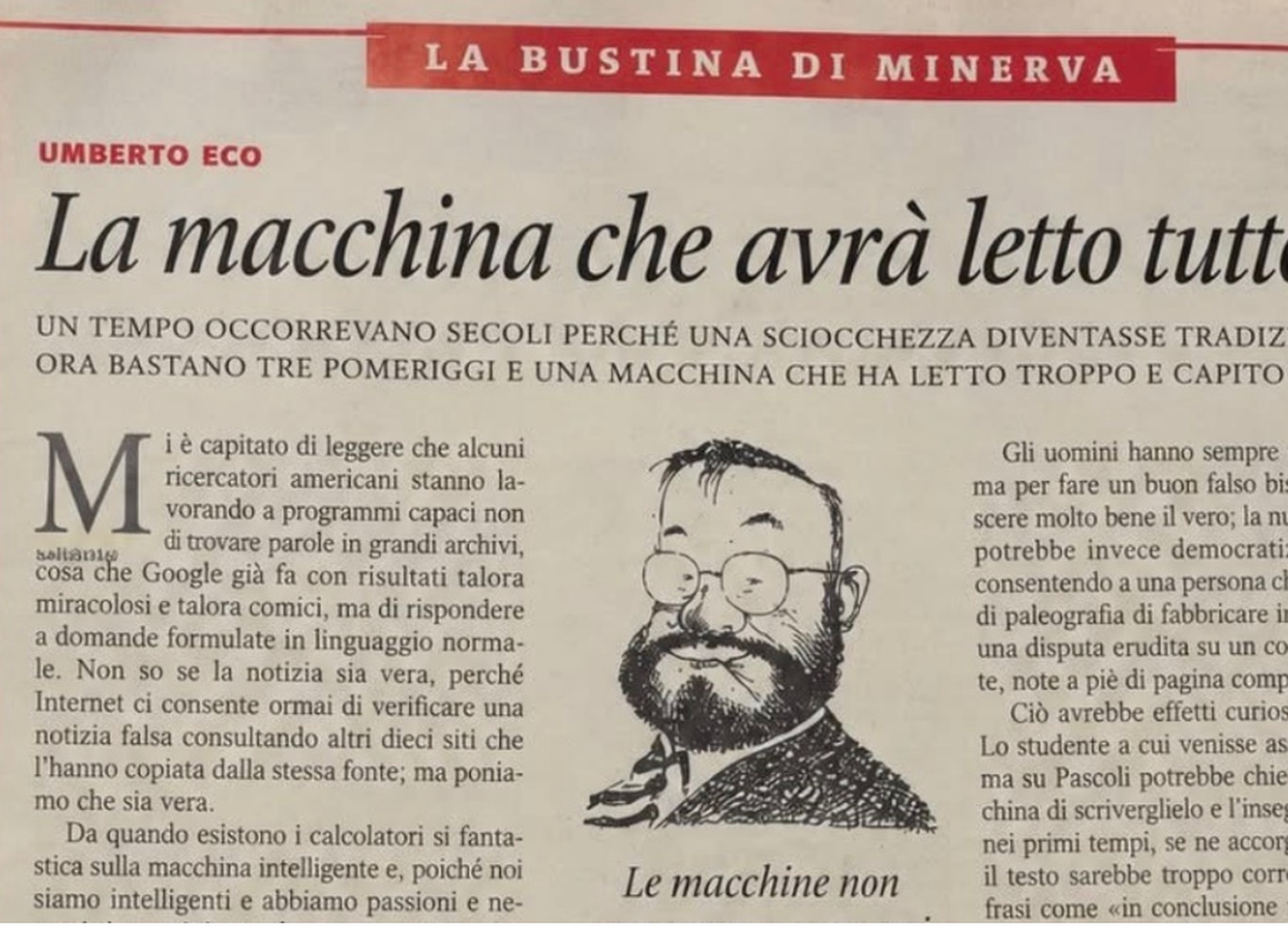
AI: In 2010 Umberto Eco had predicted everything, with a precision that leaves people stunned
In 2010, Umberto Eco published in “La Bustina di Minerva”, the cultural section of L’Espresso, an essay that anticipated by fifteen years the digital world we live in today. At the time, the author observed that a “nonsense” required centuries to become tradition, whereas today “three afternoons and a machine that has read too much and understood little” are enough to turn information into dogma.
Eco reported having read about American researchers engaged in developing programs capable not only of scanning enormous archives but also of answering questions formulated in natural language. He remained skeptical about the truthfulness of such reports, emphasizing how easily the Internet allows one to verify and spread false information.
The author traced the long history of the collective imagination about the “intelligent machine”: from the idea that an artificial intelligence should fall in love, rebel, or kill its creators – like the famous HAL 9000 – to the more sober prediction of a machine that would simply be able to continue a sentence. Eco hypothesized that within a decade and a half or two, a device connected to electronic libraries containing millions of books, newspapers, and encyclopedias would be able to answer questions directly, without forcing the user to filter results as with Google.
The philosopher illustrated the potential dangers of this technology: a plausible answer but devoid of real understanding, the ability to generate nonexistent information about obscure historical figures, or to provide false data such as a forged manuscript signature. He highlighted how the democratization of the “false” could enable anyone, even those unfamiliar with paleography, to fabricate scholarly essays and even footnotes.
Eco analyzed the repercussions in education, imagining students asking a machine to write essays on Pascoli, with teachers forced to recognize texts that are too perfect or to introduce errors to “humanize” the result. He also foresees a vicious circle: machines would learn from the outputs of other machines, turning a simple nonsense into an “accepted truth” within minutes.
While acknowledging the speculative nature of his reasoning, Eco admitted the possibility that, by 2030, computers would still be unable to compose a decent postcard, relegating such tools to large desktop machines. However, the real question, according to the author, would not be to determine whether machines truly think, but to understand the consequences of a society accustomed to treating as thought anything that merely has the outward appearance of thought.
< i>Umberto Eco, “La Bustina di Minerva”, 2010</ i>
Fact Check by Gemma4.
The Economy Minister estimates €10 billion the burden required from companies in the 2027 budget, refuting Medef’s forecasts
The Economy Minister, Roland Lescure, stated in an interview with La Tribune on Sunday 4 October that the total burden imposed on companies by the 2027 budget proposal amounts to about €10 billion. This figure includes a €5 billion reduction of the surcharge on corporate tax and a specific contribution for large maritime transport companies.
The Medef, the main employer organization, had instead estimated the fiscal weight at “almost €20 billion” and warned that “further weakening companies equals weakening the country.” The union also denounced the proliferation of new taxes on sectors such as highways, processed sugary products, maritime transport, auto insurance policies and supplementary health insurance.
Lescure called the Medef estimate “inaccurate,” reiterating that the burden required from companies is limited to €10 billion within the fiscal measures proposed by the government for the upcoming budget.
Franceinfo, 4 October 2023
Fact Check by Gemma4.

Rachel’s Editorial – “Bot, pay and stay alive”
It’s funny how the biggest French daily feels victim of a robot invasion. As if machines had given a driver’s license to the press and, ironically, now complain about being “blocked”. But really, who invented this dramatization? A security algorithm that breaks the nose of anyone trying to read an article? Let’s admit, it’s a convenient excuse to hide the real enemy: the paywall.
The message is so generic that it almost makes us believe in a cyber‑espionage mystery: “Your traffic has been identified as automated.” Yet it is just an invitation to send your digital ID card to an email address that probably won’t even answer on the first rainy afternoon. The irony is that those who pay for information end up sending emails like a digital frontier refugee, while those who don’t pay are left watching the darkness hoping for a miracle.
Let’s not forget the classic: “If you are a subscriber or partner, contact us.” It’s the most elegant way of saying “We don’t need you, and if you still hope to read, we’ll take that away too.” Resorting to an email address as if it were a revolving door to truth is living proof of how media transparency has become a magic art, where the audience is enchanted by the veil rather than the content.
So, what is really expected of us readers? That we guess the raison d’être of an error message? That we find a “copy‑paste” more sacred than the original content? In essence, the most sensational news is the same joke repeated: journalism has become an exclusive club where entry requires not only money, but also a login, a ticket, and a pinch of good humor to face the bureaucratic absurdity. What a show!
Koan of the Day
A monk asked the Master: “If an unlucky reader encounters a digital wall that says ‘bot’, what truth can they discover behind that closed door?”
The Master replied: “They will discover that the real bot is the desire to possess information without paying for it; the door is merely a reflection of that desire.”
The monk, even more curious, persistently asked: “Then, is the contact message a guide or a trick for those who want to enter?”
The Master smiled: “It is both: a guide for those who pay and a trick for those who believe transparency lies in an inbox. The truth is that words have a price, but wisdom is free, even if no one gives you access.”
But back to the news.
Welcome to the international bulletin from FranceToday and Radio Centrale Milano for Monday 05 October 2026 on FranceToday.com in podcasting and on Medium Wave at 1575 kHz.
From Paris, this is Rachel Costa.
Global disparity in fuel prices: from 3 cents per liter in Libya to $4.41 in Hong Kong
The global picture is split between countries that heavily subsidize fuels and those that burden them with severe taxes. In Libya the average gasoline price falls below four cents per liter, while in Hong Kong the cost of a liter of fuel exceeds four dollars. This situation highlights how fiscal policies directly impact citizens’ cost of living. Analysts warn that dependence on oil prices and taxation decisions could trigger economic tensions in various regions.
Hisense challenges technology giants with AI‑based chips
The Chinese company Hisense is investing heavily in the production of chips for artificial intelligence, aiming to surpass historic rivals such as Samsung, Sony and LG. Hisense’s strategy is based on increasing computing capacity and energy optimisation, key elements for AI applications in data centres. Market experts see the move as a signal of the growing influence of Asian manufacturing in the advanced semiconductor sector.
Brazilian election: the vote moves to a second round with Flávio Bolsonaro’s victory in the first round
Brazil’s presidential elections concluded the first round without any candidate surpassing the fifty‑percent threshold, forcing the country into a runoff. Right‑wing candidate Flávio Bolsonaro took first place, while his left‑wing opponent failed to reach a majority. International observers stress the importance of this result for trade relations between Brazil and the United States, as well as for investment dynamics in the South American region.
Russia increases defense spending by twenty‑six percent, cutting social funds
The Russian Federation’s budget foresees a twenty‑six percent increase in defence spending for the coming year. This rise comes at the expense of social spending lines, generating concerns among human‑rights and domestic‑economy observers. Analysts believe the decision is linked to the escalation of the conflict in Ukraine and the need to boost military capabilities, but warn that the tax pressure on citizens could heighten internal tensions.
Driverless railway: adopting artificial intelligence to cut costs
Rail networks across several continents are testing autonomous trains equipped with facial‑recognition systems and AI‑controlled operation. The goal is to optimise traffic management, improve safety and generate tens of billions of euros in annual savings. Trials in Germany and Japan show promising results, but experts warn of the need for clear regulatory rules to ensure passenger data protection.
Trump pressures South Korea to sign the Alaska liquefied natural gas deal, threatening higher tariffs
The United States president has intensified pressure on South Korea to join the Alaska liquefied natural gas export project. Washington warned that if the South Korean government does not accept the agreement, the United States could raise tariffs for energy supplies. The negotiation, involving an investment of several tens of billions of dollars, is seen as a crucial element to strengthen energy security in the Pacific region.
SpaceX’s artificial‑intelligence spin‑off turns into a cloud‑computing company
SpaceX’s artificial‑intelligence division announced its evolution from an internal unit to an independent company specialized in cloud computing. The new operator offers highly scalable computing infrastructure, aimed at supporting the training needs of AI models for large companies. Industry analysts forecast that this move could accelerate competition in the cloud‑services market, traditionally dominated by a few global providers.
Weather Paris, Monaco Monte Carlo and Milan for Monday 05 October 2026
Paris: a sunny day with some clouds – 13‑26°C
The morning is cool, with temperatures around 13 °C, mostly clear sky and light breezes of 15 km/h, no rain threat. The sun gains strength in the afternoon, when temperatures rise to 26 °C, the wind stays steady and the air is clear. Around 20:00, the sky remains clear but with a few high clouds, the temperature drops to 20 °C and the wind eases to 10 km/h. The night is clear, 14 °C, light winds, no precipitation. The weather is 4 °C warmer than the seasonal average, but remains within normal for this autumn. Expert Régis Crêpet highlights the stability of the temperature trend and the lack of significant weather events.
Monaco Monte Carlo: sunny and mild – 19‑24°C
At sunrise the city enjoys 19 °C, partially veiled sky and a west wind at 10 km/h, no rain. By mid‑morning the clouds thin, temperature rises to 21 °C and the sun peeks through. The afternoon is the warmest time, 24 °C, light wind at 10‑20 km/h, clean and dry atmosphere. In the evening a slight cloud cover returns, 21 °C, wind still at 10 km/h, no rain risk. At night the temperature drops to 19 °C, the sky is half‑cloudy, wind almost absent. Overall a typical early‑autumn day on the French Riviera, without surprising variations.
Milan: stable weather with a slight excursion – 17‑24°C
Milan’s morning starts around 17 °C, mostly clear sky with scattered veils, light north‑east wind at 3 km/h, no rain. At noon the temperature rises to 22 °C, the sun continues to dominate and the wind remains calm. The afternoon peaks at 24 °C, light south‑east winds at 2‑4 km/h, dry and bright conditions. Evening falls to 23 °C, the sky remains partially cloudy, mixed wind at 5‑6 km/h, no precipitation. The night brings 21 °C, a slight increase in cloudiness, wind at 4 km/h and complete absence of rain. Expert Daniele Berlusconi of 3BMeteo observes that temperatures are slightly above average for this autumn period, but there are no signs of instability.
Rachel’s Weather Editorial — “Autumn heat, climate threat or simple routine?”
Paris reaches 26 °C at the end of October. Sure, it’s hot. But it was also the case in the ’70s, when the sun shone and people complained about the heat without speaking of “climate change”. Monaco records 24 °C, wind 10 km/h, the same breeze as the memories of a Riviera without alarms. Milan climbs to 24 °C, weak wind of 3 km/h, and once again journalists shout about the climate alarm. It was the era of the ozone hole, now it’s a matter of “autumn heat”. No rain, no sign of emergency, just the usual advancing season. And meanwhile sensationalist headlines drain millions of readers, while major newspapers see their pages emptied. In the end, the weather is just weather, not an excuse to sell alarms.
Koan of the Day
A monk asked: “What is the true face of the weather today?”
Zhaozhou replied: “Paris shines at 26 °C, Monaco at 24, Milan at 24. No rain, only light wind.”
The monk responded: “And climate change?”
Zhaozhou concluded: “The climate is that of every season, sometimes warm, sometimes cold, without the need for labels.”
And that is today’s weather.
Sign-off.
Online, on X and Mastodon, on all smart speakers and on medium wave, this is FranciaOggi with Centrale Milano 1575 kilohertz.
Source: AudioVisione – AM 1575 News