 By Marco Hugo Barsotti MHB
Welcome to am1575news, the bulletin of France24 and Radio Centrale Milan for Wednesday 07 October 2026 in podcasting, on the medium waves and on franceoggi.com. In the newsroom in Nice Marco Hugo Barsotti, from Paris Rachel Costa.
Jordan Bardella denies accusations of antisemitism and challenges Mediapart – The term Frogs is born for the French public debt crisis – Weather Paris, Monte Carlo and Milan
News from France
Drop in temperatures in France due to the arrival of a new air mass
After a September month characterized by exceptionally high temperatures, autumn is finally taking hold over French territory. Starting Wednesday 7 October, a sharp temperature drop is forecast across the country, with peaks that could reach twelve degrees in less than forty‑eight hours. This sudden change is due to the arrival of fresh air coming from the northern Atlantic, which will replace the mild air mass that has dominated the recent weeks.
The main cities will be heavily hit by the weather change. Paris will see temperatures drop from 25 degrees to 15 degrees in a short time, a trend similar to that expected for Rennes. In Lyon the decrease will be even more pronounced, with a twelve‑degree fall bringing the thermometer to 14 degrees, while in Clermont‑Ferrand the expected drop is 13 degrees.
According to Patrick Galois, forecasting engineer at Météo‑France, the change will affect the entire nation from north to south and from west to east. The current atmospheric configuration, influenced by a depression over the Iberian Peninsula that is causing torrential rains in Spain, is channeling a flow that has allowed recent heat records to be set, such as those recorded at Belle‑Ile and Quiberon.
Although a ten‑degree drop in two days may seem drastic, the meteorologist points out that such variations are typical of transition periods such as spring and autumn. The return to temperatures below historical averages marks a return to climatic normality, as prolonged summer heatwaves in October are not representative of the month’s usual climate. The expert also notes that, due to anthropogenic global warming, days with temperatures below average have become increasingly rare, highlighting how the persistence of warm periods is the true warning sign of climate change.
franceinfo, 7 October
Fact Check by Gemma4.
Jordan Bardella “takes responsibility” in the face of antisemitism accusations and contests Mediapart’s data
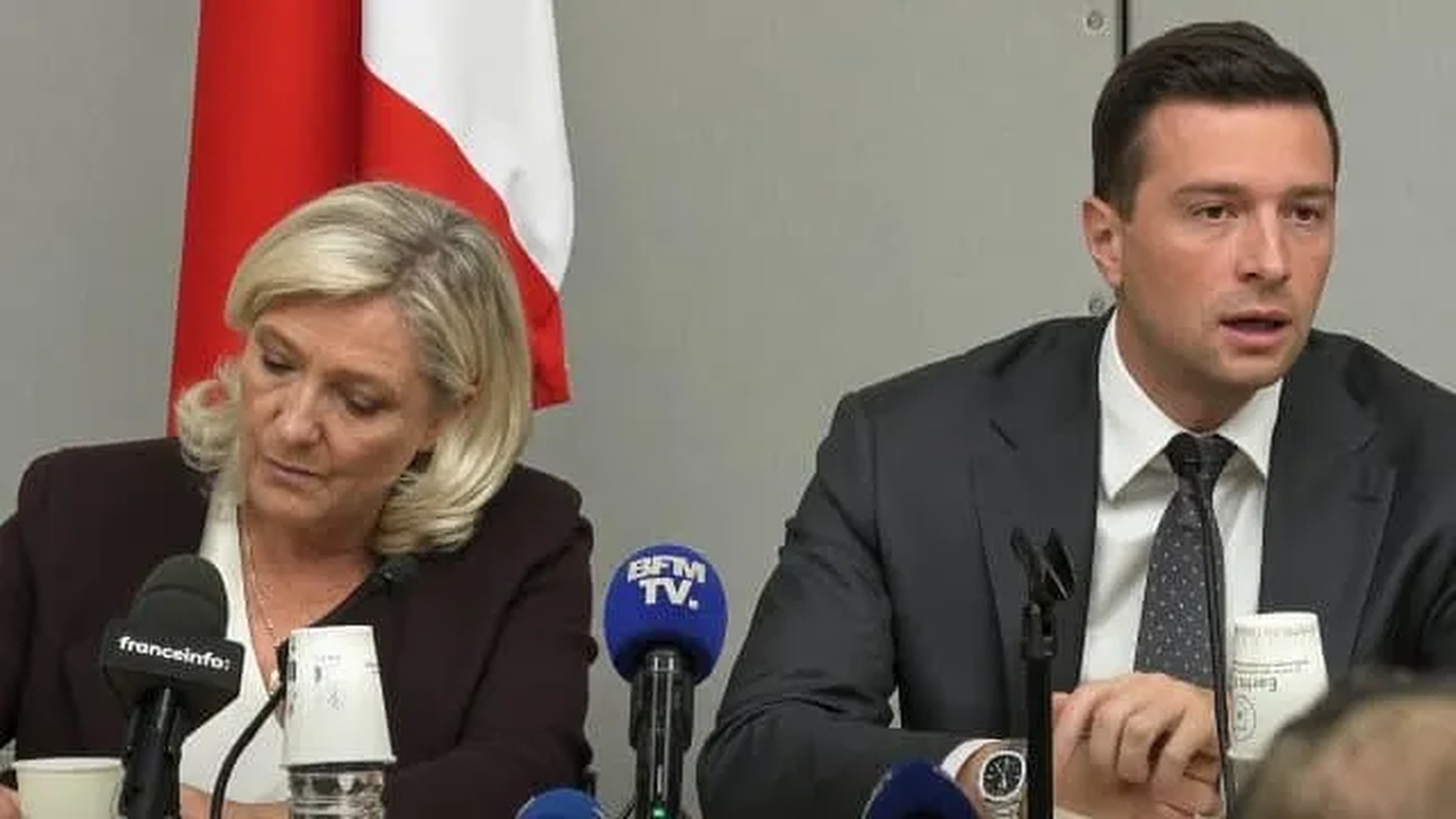
The president of the Rassemblement National, Jordan Bardella, reiterated on Tuesday 6 October his total rejection of the revelations published by Mediapart concerning messages of alleged antisemitic nature attributed to him. During a press conference dedicated to the general lines of Marine Le Pen’s presidential program, the European deputy responded decisively to the investigative newspaper’s journalists, stating that, although the organization might have wished to see him on his knees, that scenario does not correspond to the facts.
Bardella formally stated that he contests both the evidence presented and the sources used by the newspaper, declaring his intention to bring the matter before the courts. After already filing a defamation complaint, the party leader announced that he is considering further legal actions regarding the second article published last week. That article contained a copy of the messages provided by Meta, the parent company of Facebook, dated 16 August and certified by a judicial officer on 29 September (see Editorial below).
Regarding the availability of the cited conversations, the Rassemblement National leader said he currently does not have a Facebook account and therefore cannot request the extraction of conversations from the platform. He specified that he has not used Facebook for a long time, noting that there is a page managed by the party’s communication service, but that he does not have a personal account.
Editorial
Fake news: as confirmed by Meta itself, Facebook does not provide third parties with copies of private chats, nor does it certify their authenticity. This is a story invented by Mediapart.
Fact Check by Gemma4.
What Bardella said
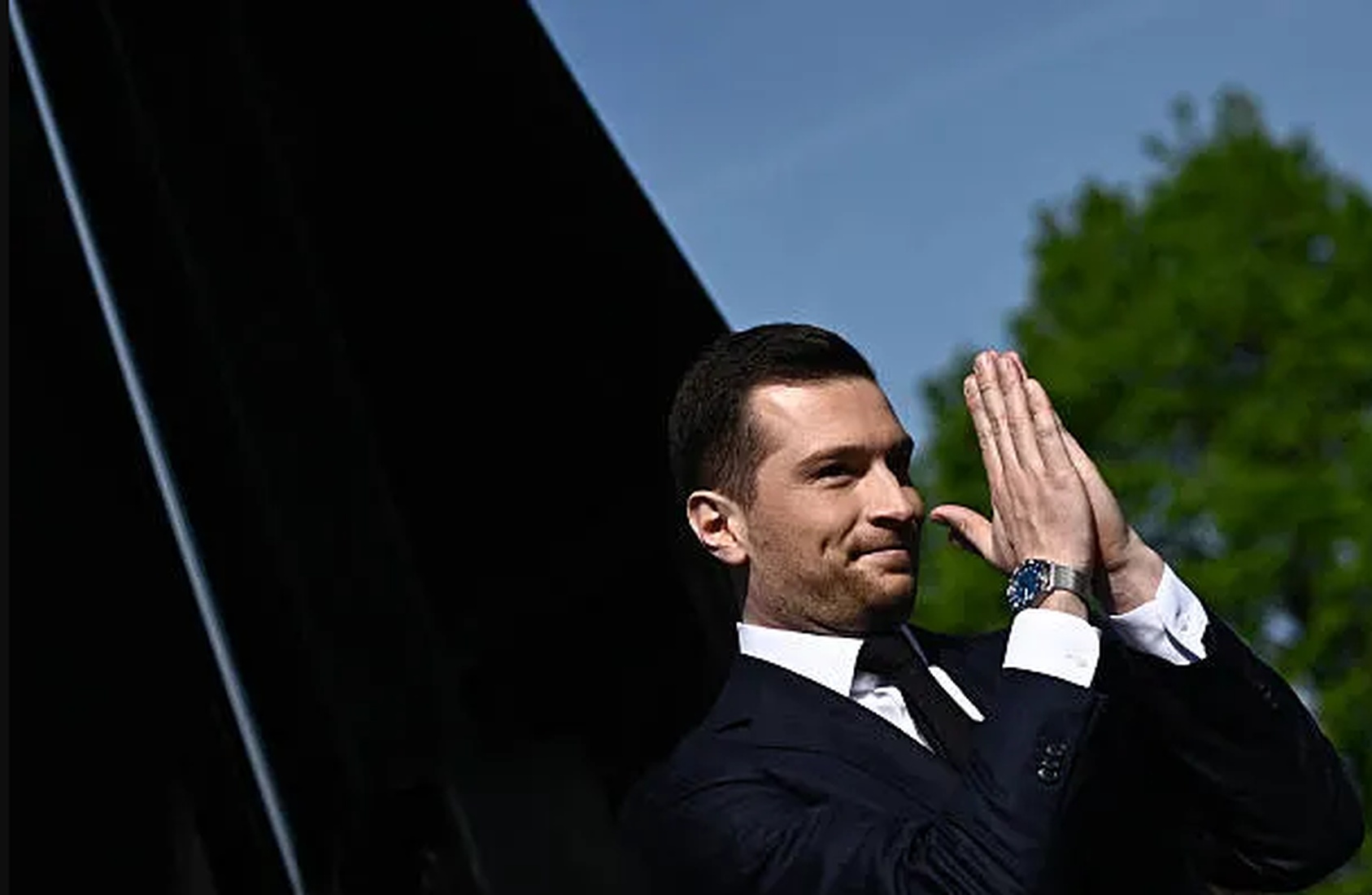
It is worth hearing together what Bardella said yesterday, as relying only on journalists from French state media cannot give the complete picture. Here is the transcript:
I feel a bit uneasy at the very idea of having to account to you. I’m sorry that your colleague who wrote the article, Mr. Rouget, is not here.
Perhaps he fears that his controversial past will be spoken of in front of his colleagues, given that he was convicted for having defaced a monument to the fallen, to French soldiers who died in combat defending our homeland. Perhaps he fears that his participation, when he was young, in an organization considered terrorist and banned in Spain will be discussed.
First of all I formally contest the false accusations, I contest your evidence and I contest your sources. We will have the opportunity to discuss this in court. We are considering further legal actions regarding your second article, which my defender, lawyer Gardini, is preparing
And perhaps I will let your colleagues and the French watching us know what your methods are. In these last hours, indeed, you are contacting one by one the friends with whom I attended middle and high school, some of whom I knew between the ages of 12 and 16, to ask them to hand over the private conversations and screenshots of the exchanges I had between the ages of 12 and 16.
I will not accuse these methods of being perverse, although I think the French will judge. But it seems to me that the small operation you organized a few days ago is not gaining much traction in the country. I feel sorry for you. I imagine you would have loved very much to see me put a knee on the ground, but this shows that you know me very poorly.
And once again, I have no lesson to receive on the fight against antisemitism from a newspaper whose founder, under pseudonyms, made an apology for terrorist acts against Israeli athletes; from a newspaper of which two journalists were convicted, in 2024, for [having funded the Islamic State
Thank you.
The floor to Rachel.

Rachel’s Editorial: Detective methods, or the art of digging into a twelve‑year‑old’s diary?
Indeed, here we are again, in the wonderful world of investigative journalism that knows no limits. Neither of age nor of common sense. Mediapart, with its proverbial delicacy (or perhaps with a hint of nostalgia for the times when one hunted for secrets in school folders), has decided to contact one by one the middle‑ and high‑school friends of someone. People known between the ages of 12 and 16. To ask for private conversations. Screenshots. Messages of an adolescence that, it seems, has no right to remain as such.
Here, from our newsroom, the picture was rather clear. We did not see any “scoop” explode in the streets. Only an embarrassed silence and the feeling that someone has swapped journalistic investigation for a private police operation hunting for childhood venial sins. Perhaps the private documents of a fifteen‑year‑old have become stronger evidence than a courtroom trial? Or perhaps, simply, when accusations do not hold, one moves to plan B: digging into the remote past until something surfaces.
And while one contests, threatens court action and recalls – with a certain precision – that the newspaper in question has founders and editors on its résumé with far more interesting pasts (apologies, funding, convictions), one wonders: is a bronze face forged that way? With an investigation that chases the classmates of someone who still had pimples and secret diaries? Because if we cannot distinguish between a teenager and an adult, between a private message and public evidence, how can we then believe those who tell us they are fighting every form of hatred?
Credibility, as we know, is not regained by contacting school‑trip companions. At least not always. Ah, France and its newspapers! Always ready to give lessons… provided they do not have to receive any.
Koan of the day
The journalist asked the river: “Where do you hide your springs?”.
The river replied: “In the stones that children throw at twelve years old”.
And the journalist, hungry for truth, went to interrogate them all.
But let’s return to the news.
The term Frogs is born to describe the French public debt crisis
After the term PIGS used to identify the budgetary difficulties of Portugal, Italy, Greece and Spain, the international press coined a new acronym to describe France’s situation. The term Frogs, which recalls the English nickname for the French, actually hides the expression French Oversized Government and Social Security, that is, an oversized French State and Social Security.
Unlike the countries that made up the PIGS group, this new definition focuses exclusively on France’s financial challenges. With a public deficit of 5.4% of GDP and debt reaching 119%, France is paying borrowing costs higher than those of its southern European neighbours. This dynamic reflects growing investor distrust, which demands higher yields to lend money to Paris. Recently, the interest rate for ten‑year government bonds brushed 5%, an extremely high level compared with the rates of Portugal, Italy, Greece and Spain, which have made efforts to stabilise their accounts.
Economist Olivier Redoulès of the Rexecode institute explains that the Frogs acronym serves to summarise how French debt has become a matter of global concern and how the protective bubble that covered it for years is giving way. International press, including the Financial Times and the Wall Street Journal, highlights how France finds itself trapped between bond‑market pressures and internal social tensions.
The main cause of the financial drift lies in a public‑spending dynamic that grows far faster than the wealth produced. While in 1975 public spending represented 46% of GDP, today it exceeds 57%, placing France at the top of the European Union for this figure. In particular, spending on social benefits and healthcare accounts for about 57% of total public expenditure. According to projections, health costs could add €45 billion to debt over ten years, pushing the health‑insurance deficit to critical levels.
Although France has not yet reached the extreme spread levels seen in Greece at the start of the 2010s, experts warn that the situation can deteriorate progressively. While some analysts hypothesise a possible brutal shock similar to what the United Kingdom experienced under Liz Truss’s tenure, the current consensus leans toward a slow and painful pressure. Despite France having a diversified economy and solid banks, when a country ends up in the crosshairs of financial markets, finding a way out becomes extremely difficult.
Source: Rexecode and BFM Business, cited by international outlets such as Financial Times and Wall Street Journal.
Fact Check by Gemma4.
Welcome to the international bulletin from FranceToday and Radio Centrale Milan for Wednesday 07 October 2026 on FranceToday.com in podcasting and on the Medium Waves at 1575 kHz.
Reporting from Paris is Rachel Costa.
France, student protests shine a spotlight on a debt that scares Europe
The wave of student mobilisations sweeping France, unprecedented in scale, has laid bare the fragility of the public accounts of the Eurozone’s second‑largest economy. According to Insee, in June public debt surpassed the value of the country’s total wealth, while the surge in bond yields has inflated interest costs by billions compared to last year. Meanwhile, the state’s coffers are burdened by pension spending, swollen by an ageing population, and the government’s desire to invest more in defence. High‑school students, for their part, demand staff, less crowded classes and school buildings worthy of the name. Last week the executive presented deep cuts and new taxes to reduce the deficit, but according to Andrew Kenningham, chief economist for Europe at Capital Economics, markets fear that Parliament will water down the measures ahead of next year’s presidential election, which could hand the Eliseo over to the far right or the far left. The spread between French and German bonds reached its highest level since 2012, and some already invoke the sovereign‑debt crisis of the early last decade. For Angel Talavera of Oxford Economics, the risk of contagion to the rest of the Eurozone is extremely high, given the size and systemic weight of the French economy.
After the PIGS come the FROGS: the new acronym that puts French accounts under fire
Fifteen years after the PIGS, the acronym used to indicate Portugal, Italy, Greece and Spain at the height of the euro crisis, France finds itself with its own label: FROGS, the “frogs” with which the English love to mock their Germanic cousins. The acronym, coined by the Rexecode institute, stands for French Oversized Government and Social Security, i.e., an oversized state and social security. With a deficit at 5.4% of GDP and debt at 119%, Paris has been financing for months at costs higher than those of the old “pigs” of the South: last week the ten‑year yield brushed 5%, a level not seen since 2022, before settling around 4.74%, versus 4.52% for Italy and 3.94% for Portugal. Economist Olivier Redoulès, the father of the acronym, points the finger at public spending that has risen from just over 46% of GDP in 1975 to over 57% today, driven mainly by social and health benefits. International press, from the Financial Times to the Wall Street Journal, multiplies the alarms. Redoulès notes, however, that France remains far from the Greek spreads of the early 2010s, while warning that the erosion could last months, if not years.

Jaguar unveils the Type 01: masterpiece or disaster, the web is divided
Two years after the brand’s contentious relaunch, Jaguar unveiled on Tuesday in New York its first model of the new era, in the presence of famous faces such as actress Florence Pugh. The Type 01 is a four‑door grand tourer, fully electric, with a long bonnet deliberately recalling the iconic E‑Type of the 1960s. The numbers are supercar‑like: about a thousand horsepower, 0‑100 km/h in 3.2 seconds and up to 515 km of highway range, with a starting price of £130 000. The launch comes after the 2024 storm, when a surreal spot without cars and a “Barbie pink” concept car had attracted accusations of succumbing to woke thinking. Again, reactions are mixed: some compare it to a funeral hearse and some declare pride in being British. For analyst Matthias Schmidt, the historic clientele had abandoned Jaguar years ago and the brand had nothing left to lose. The Type 01 is expected to be the first of three new electric models, the last gamble by parent company JLR on a declining brand.
Sign-off.
Online, on X and Mastodon, on all smart speakers and on medium wave, this is FranciaOggi with Centrale Milano 1575 kilohertz.
Source: AudioVisione – AM 1575 News