 By Marco Hugo Barsotti MHB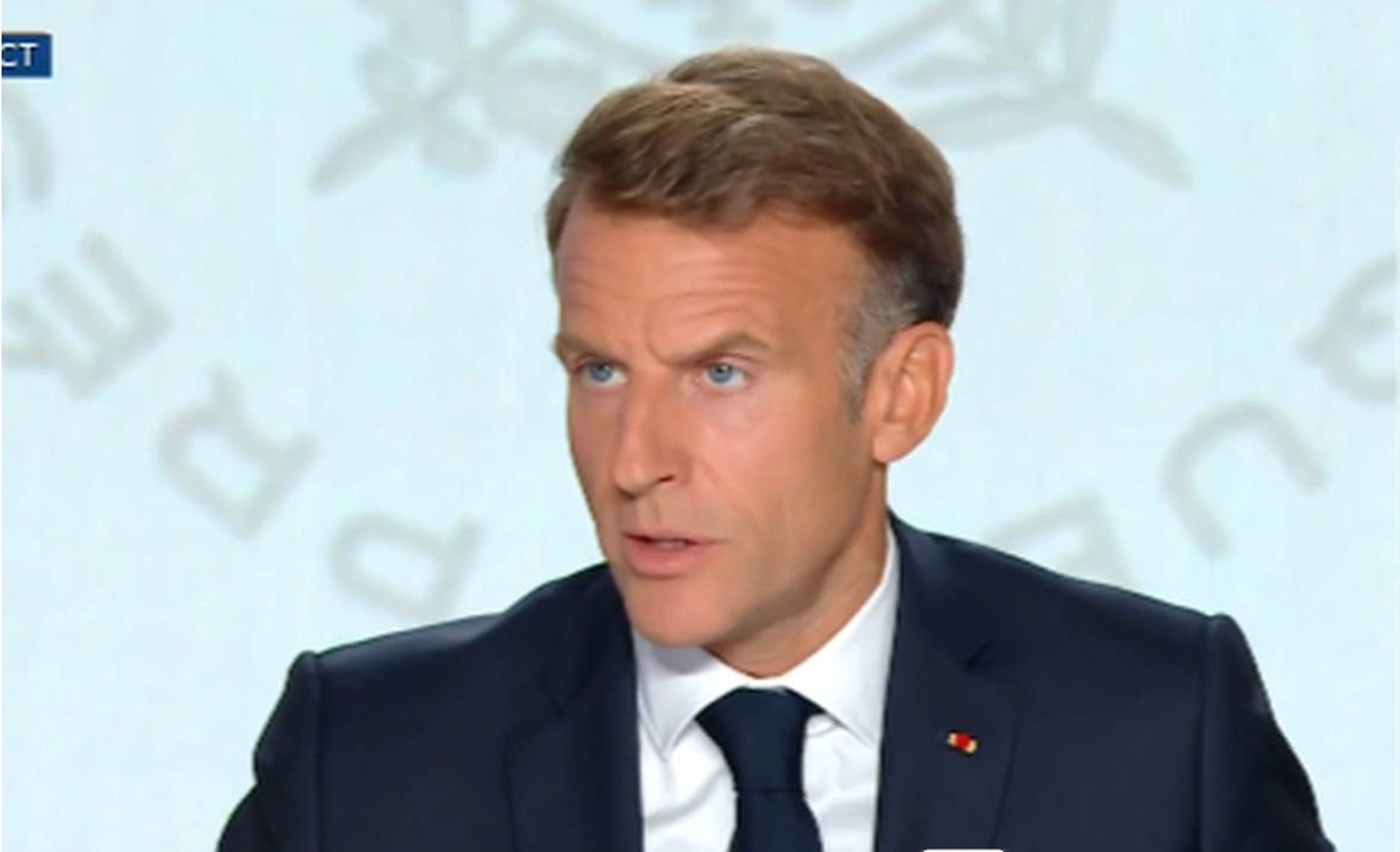
Welcome to am1575news, the news bulletin of France24 and Radio Centrale Milan for Friday September 25 2026 in podcasting, on the medium waves and on franciaoggi.com. In the editorial office in Nice Marco Hugo Barsotti, from Paris Rachel Costa.
Louis XIV in France and on Short Waves – Macron on TV: “It’s not me, it’s the others” – Paris, the spread – soaring, investor distrust – Weather Paris Monte Carlo Milan
News from France
How to follow the visit of the pope on Short Waves
On 19 June 2025 the current Pope, Louis XIV made a surprise visit to the broadcasting centre of Radio Vatican. Not to the studios, which are essentially located in the Vatican: precisely at the historic broadcasting site of Santa Maria di Galeria, home to imposing antennas that, in the ’90s, were controlled by a Sun Microsystems workstation. The visit was particularly important, after that during Bergoglio’s pontificate Radio Vatican had been ignored to the point of deleting its website in favor of a generalized informational project where neither programs nor frequencies were found.
But Louis is different: in an interview he reiterated the importance of a medium – amplitude modulation AM – which he himself had long used as a listener: when a missionary in Latin America and Africa, to stay in contact with the world.
Louis therefore knows how important a type of broadcast that can be listened to with cheap low‑cost radios that consume very little energy, that of two simple AA batteries. We therefore celebrate his visit on French territory with the list of Short Wave broadcasts dedicated to this event.
On 25 September the Pontiff will arrive at UNESCO in Paris. The short‑wave transmission will start at 14‑50 Italian time on 17 540 kHz in English and on 17 525 kHz in French. After the institutional address, at 17‑10, he will take part in the Vespers, followed by a youth gathering at the Stade de France from 20‑55 to 22‑30, broadcast on 9 705 kHz in English and on 11 870 kHz in French.
On 26 September the Mass celebrated in Place de la Concorde will also be broadcast on 17 540 kHz (English) and 17 525 kHz (French) from 14‑50 to 16‑30. In the evening, the prayer in the Lourdes Grotto will be transmitted on the same frequencies from 19‑30 to 20‑10.
On 27 September, between 10‑50 and 12‑20, the Mass and the Angelus will again be on air on 17 540 kHz (English) and 17 525 kHz (French). The Rosary, however, will be broadcast in the evening from 20‑45 to 22‑00 on 9 705 kHz in English and on 11 870 kHz in French.
On 28 September the trip will culminate in Metz, where from 09‑50 to 12‑00 the Pontiff will take part in an interreligious meeting and the series “At the Roots of Europe for Peace and Unity”, still on air on 17 540 kHz (English) and 17 525 kHz (French). In the afternoon, in the cathedral of Saint Stephen, he will celebrate the Mass from 15‑50 to 17‑30, with the live broadcast on the same frequencies.
In Italy Vatican Radio will broadcast the entire programme on the DAB network ClubDAB, on channel 733 of DTT and, in Rome, also on FM at 105.00 MHz and 103.80 MHz. radionizza.it, 25 September 2026 Fact Check by Gemma4.
Macron on TV: “It’s not me, it’s the others”
The President of the Republic, back from the United Nations General Assembly in New York, spoke on France 2 about the fuel crisis and the growing Russian threat, making clear that he acts but his hands are limited.
In the interview with Gilles Bouleau and Caroline Roux he painted a bleak picture of the geopolitical situation, highlighting the increase in Russian provocations – cyber‑attacks, disinformation and hybrid operations – and citing the incident of explosive drones almost intercepted at Leipzig airport, which could have caused casualties on German soil. He emphasized that Russia sees Europe as the “strategic depth of Ukraine”, yet has not yet directly struck French territory.
On the conflict in Ukraine the head of state recalled its catastrophic human cost, speaking of about 1.5 million deaths, and reported ongoing diplomatic initiatives, including a proposal for an “energy double moratorium” and the strengthening of military support to Kyiv.
The core of the interview concerned the concrete repercussions for citizens: the surge in fuel prices. Macron acknowledged that it is “normal to be angry” in the face of heavier bills, but called for national unity, rejecting the idea of a social movement against the Russian war and the tensions in the Strait of Hormuz. He defined his priority as “bringing prices down through diplomacy”, focusing on reopening the strait, streamlining supplies and a possible coordinated release of strategic oil stocks by the G7.
The president announced the dispatch of French military assets to protect oil facilities in Saudi Arabia, specifying that it will involve soldiers, radars and defence systems to safeguard the Yanbu site, without committing France to further conflicts. He defended the price cap implemented by TotalEnergies, stating that without the company such a limit would not even exist, and he did not rule out a tax reduction in the future, but preferred “targeted aid”, more efficient and less burdensome for public finances.
On the budget plan, Macron invoked a “responsibility budget” that maintains objectives without mentioning austerity, confirming that he does not regret the “all‑out” policy adopted during previous crises, but admitting that he has not convinced on some structural reforms, including the pension reform. When asked about the possibility of dissolving the National Assembly in case of a deadlock, he answered categorically that “it would not be good for the country”, emphasizing that eight months before the presidential elections such a decision would increase instability and limit the future successor’s margin of manoeuvre.
In summary, Macron’s speech sought to closely link international diplomacy to the daily life of the French, calling for collective responsibility in a context of multiple crises, but without providing concrete indications on further fiscal interventions. Infodujour, 24 September 2026
Fact Check by Gemma4.

Rachel’s Editorial – Macron on TV: blame on others, sky‑high prices and foggy promises
Macron has returned in front of the camera as if he could turn a press conference into a recipe for price reduction. Between a reference to “explosive drones in Leipzig” and the promise of “national unity”, we wonder: is his strategy a genuine plan or simply a series of siren sounds to silence activists? Perhaps the answer is hidden beneath the diplomatic carpet that rolls toward the Persian Gulf, where French soldiers patrol to protect an oil tank.
The president is right to say that citizens’ “anger is normal”, but hearing it while saying nothing concrete will be done is like offering an ice pop to someone who is frozen. Having a “responsibility budget” without naming the word “austerity” sounds more like a euphemism for “spend where we can and hope the public doesn’t notice”. The climate gets even colder when, asked about a possible dissolution of the Assembly, he replies that it would not be “good for the country”. Good for whom? For those who still have a job to protect with drones?
He is unable to lower fuel taxes, calling it “demagogic”. Strange, because the same definition could be used for his habit of turning every crisis into a media campaign. The evasion of pension reforms, the long‑term defence of the price set by TotalEnergies and the “targeted aid” all sound like tools to maintain a precarious balance between public finance and public confidence, the latter evidently running low on fuel.
In short, the interview is an exercise in balancing: one step toward diplomacy, two toward the reality of citizens at the ticket window, three toward defending other people’s energy interests, and finally, a cat‑like leap into a hole to avoid falling into the trap of a dissolution. Macron says he is not to blame, but his words sound like an old script revised many times. Is it a script or his only recipe?
Koan of the day
Monk: Master, why does a leader who promises to lower fuel prices end up sending soldiers to a distant oil site?
Master: Because whoever wants to extinguish the fire of the journey first lights the beacon of security; the soldier’s shadow is lighter than the weight of the price.
Monk: And if the people continue to demand lower taxes, how can the honour of a government be reconciled with the hunger of a scale that never stops tilting?
Master: When the scale tilts, the sage does not adjust the dishes but removes the weight of pride; true lightness is to pay with dignity and not with air.
But let’s return to the news.
Investor distrust towards France intensifies: Paris borrows at nearly 4.7 % and sees the rate gap with Germany reach the highest level in 14 years
In a context of global sovereign rate increases, France records growing investor distrust. The differential (spread) between the yields of French 10‑year bonds and German ones has widened to 111 basis points, the highest level since 2012, a few days before the budget debates begin in Parliament.
The yield of French 10‑year bonds is 4.68 % versus Germany’s 3.57 %. The faster rise of the French rate compared to the German one marks a specific tension on the Hexagon. The spread, which measures the risk premium required by investors, has risen from 0.82 percentage points a year ago to over one and a half today, and it has also widened relative to Italy, Spain and Greece.
On the international front, the global bond market dynamics are rising. The Bloomberg sovereign index reached 3.99 %, the highest since 2007, driven by favorable economic data and the rebound in oil prices. In the United States, the 10‑year yield rose by 0.2 percentage points, the strongest daily gain since April, while the 30‑year reached 5.44 %, the highest since 2004. Japanese 10‑year bonds also touched 3.08 %, the highest level in thirty years.
Investors, according to portfolio manager Ed Al‑Hussainy of Columbia Threadneedle, are demanding higher yields to commit capital long‑term, making sovereign bonds more attractive than equities. This flight to bonds has pushed European stock markets lower, fueling fears of further capital outflows.BFM TV, 24 September 2026 Fact Check by Gemma4.
Maria Carolina de Bourbon: admired in Rome for entering the Sovereign Order of Malta
The twenty‑three‑year‑old princess experienced, on Wednesday 23 September, a moment she will hardly forget. Alongside her sister Maria Chiara and her parents, Maria Carolina de Bourbon des Deux‑Siciles was admitted into the Sovereign Military Order of Malta with the title of Dame of Honor and Devotion. The ceremony, celebrated in the grand chapel of Saint John the Baptist in Rome, took place in the presence of Fra John T. Dunlap, Prince and Grand Master of the Order.
After making public her relationship with the leader of the Rassemblement National Jordan Bardella, the princess again attracted media attention. On 5 September, the couple had participated in the Ambrosetti Forum in Cernobbio, where the politician gave a speech and highlighted his partner’s support. However, it was the recognition by the Order of Malta that placed the young aristocrat at the centre of interest.
On her Instagram profile, Maria Carolina shared images of the day, describing the Order’s historical value: “A thousand years of history continue to live today through the Order of Malta and its commitment to faith, charity and service to those most in need.” She then commented on her entry: “In Rome I had the honour of being admitted as Dame of Honor and Devotion, in the presence of His Most Excellent Highness Fra John T. Dunlap, Prince and Grand Master.” The princess concluded the post stating she is “enthusiastic to be part of this centuries‑old tradition, helping to advance these values and dedicating herself to the causes closest to me.”
Maria Chiara, the sister, also received the same title in the same context, sharing photos of the ceremony and emphasizing the importance of the Order’s spiritual and charitable commitment.
Source: Gala, 24 September 2026.
Fact Check by Gemma4.
Welcome to the international bulletin from FranceToday and Radio Centrale Milan for Friday September 25 2026 on FranceToday.com in podcasting and on Medium Waves at 1575 kHz.
From Paris, this is Rachel Costa.
The Pope’s visit to Paris attracts hundreds of thousands of faithful
The Catholic religious leader arrived in Paris for two days of celebrations, with a Mass on the Champs‑Élysées that gathered more than six hundred thousand people. Authorities blocked traffic on several main arteries of the capital and deployed an impressive police contingent to ensure the safety of participants. The event, the largest papal gathering in Europe since the last Olympic Games, provided a moment of spiritual unity in a continent still shaken by geopolitical tensions.
French authorities also scheduled a series of live television broadcasts, allowing millions of viewers to follow the ceremonies from their homes. Experts note that the Pope’s presence in Paris could strengthen ties between the Church and Western governments, while the mass of faithful demonstrates the persistence of strong religious devotion despite contemporary social challenges.
Macron does not rule out a reduction of fuel taxes
The French prime minister said yesterday that if fuel prices continue to rise, the government is ready to cut taxes to ease the burden on consumers’ pockets. Before any possible fiscal change, Macron stresses the need to bring pump prices down, first focusing on increased competition among distributors. This stance comes amid strong inflationary pressure, with citizens complaining about rising transport costs.
Meanwhile, the Economy Minister has launched a series of unprecedented consultations with energy producers to assess the causes of price increases. The government hopes to find a balance between consumer protection and maintaining stability of the national energy sector, while avoiding a rapid tax increase that could choke the post‑pandemic economic recovery.
Oil price falls following signals of a restart of the Hormuz Corridor
Energy markets recorded a dip in oil prices after diplomatic sources reported a possible step toward reopening the Strait of Hormuz, crucial for crude traffic between the Persian Gulf and the rest of the world. The prospect of a de‑escalation of the conflict between the United States and Iran eased investors, who feared a prolonged supply disruption.
Energy analysts highlighted that the return of navigation through the strait could reduce market pressures, removing a price risk that had allowed crude to reach unexpected peaks. Regional authorities have begun a preliminary safety assessment of the channel, while the parties involved have expressed a willingness to dialogue to mitigate tensions threatening global economic stability.
Investors push France toward higher sovereign rates
The French bond market recorded an increase in the yield spread versus Germany, reaching the highest level in the last fourteen years. Investors reacted to recent political uncertainties and slower growth forecasts, demanding a higher risk premium for French sovereign debt. France’s ten‑year debt is now rated around 4.7 % yield, a sign of growing pressure on public finances.
Fiscal authorities have tried to reassure markets, announcing spending containment measures and a structural reform plan to stimulate growth. However, the rise in bond yields suggests investors remain cautious, viewing France as still vulnerable to internal dynamics and external shocks, including energy tensions and inflation‑related challenges.
Average diesel price hits a new EU record
Data from European authorities show that the average diesel price has reached €2.40 per litre, marking the highest value recorded in the euro area. In Denmark the cost exceeded €2.56, while in Germany it was €2.46 per litre. The increase is mainly driven by the surge in crude oil prices and recent fuel stock restrictions due to geopolitical tensions in the Middle East.
European consumers have expressed concern about the impact on the cost of living, especially in transport and logistics sectors. Authorities in various states have considered introducing temporary measures to contain prices, including revising fuel taxes and promoting more sustainable energy alternatives, in an attempt to limit the economic burden on citizens.
Meta launches the Muse device, the first consumer AI on the market
Mark Zuckerberg’s company has unveiled Muse, a pair of smart glasses capable of interacting with an AI‑based virtual assistant. The product, designed for daily consumption, allows users to perform searches, translate texts and manage tasks without using their hands, thanks to voice commands and an integrated visual interface. Meta’s strategy aims to gain ground in the emerging augmented reality sector, where competitors such as Apple and Google have so far dominated.
Industry analysts, however, assess Muse’s commercial prospects cautiously, citing the need to build an ecosystem of applications and content capable of sustaining long‑term consumer interest. The device was launched at a price of $1,299, a figure that could limit initial adoption, but which the company deems necessary to cover the high development costs of the technology.
Anthropic seeks Palantir‑style voting control before the IPO
AI startup Anthropic has proposed an internal voting mechanism that grants privileged decision‑making powers to seven of its co‑founders, inspired by the governance model adopted by Palantir. The structure, if approved, would allow these members to block important strategic decisions, including possible changes in company direction, before a likely stock market listing. The declared goal is to protect the company’s original vision during the transition to the public market.
However, the proposal has raised concerns among investors, worried about a potential power imbalance that could reduce the transparency and accountability typical of listed companies. Corporate governance experts note that such concentrated control could affect investment valuation, prompting analysts to demand greater safeguards for minority shareholders’ participation in the company’s decision‑making process.
Weather Paris, Monaco Monte Carlo and Milan for Friday September 25 2026
Paris – a day of light and warmth
In the cool morning in Paris the temperature reads 10 degrees, the sky is shy and clear, the wind blows at 20 km/h with gusts up to 25 km/h, with no trace of rain. The sun becomes more pronounced in the afternoon, the thermometer rises to 29 degrees, the wind eases to 10 km/h, maintaining clear air and no precipitation. Towards evening the air remains pleasant at 24 degrees, the wind stays light around 10 km/h, the sky stays clear and the rain risk is nil. At night it wraps in a cool 17 degrees, the wind blows calmly at 10 km/h but can reach gusts of 25 km/h, still with no threat of rain. Expert Régis Crêpet confirms that the day will be predominantly clear, with temperatures above normal. In summary, during the day there is enveloping warmth, moderate wind and absolute absence of precipitation.
Monaco Monte Carlo – Mediterranean sun and light breezes
In the morning in Monaco the thermometers read 18 degrees, the sky is slightly cloudy but the sun is already felt, the wind comes from the north‑northeast at 15 km/h with gusts up to 30 km/h, with no rain. In the afternoon the temperature reaches 25 degrees, the sun shines intensely, the wind strengthens from the east to 25 km/h with gusts reaching 40 km/h, but the sky remains clear and rain is absent. In the evening the temperature drops to 22 degrees, the wind eases to 10 km/h, the sky is partly cloudy and there is no risk of rain. During the night the climate becomes more humid, with 21 degrees and a calm wind of 10 km/h, without precipitation. The careful observation of the meteorological service confirms stable and dry conditions for the whole day. In conclusion, fine weather with moderate winds and no rain threat is expected.
Milan – variable cloudiness and mild temperatures
In the morning in Milan the temperature is 17 degrees, the sky is covered by scattered clouds, the wind blows from the north‑northeast at 5 km/h, with no rain. During the day the temperatures gradually rise to a maximum of 24 degrees, the clouds thin out and the sky becomes clearer, the wind remains light, coming from the east at 6‑7 km/h, and precipitation stays absent. In the evening the temperature stabilises around 20 degrees, the sky is clear or slightly cloudy, the wind is weak at 5 km/h, with no rain. At night the temperature drops to 20 degrees, the wind remains calm at 5 km/h, and the sky stays clear with no risk of precipitation. Expert Daniele Berlusconi of 3BMeteo notes that conditions will be stable and dry, with temperatures between 17 and 24 degrees. In summary, Milan will experience a day of light cloudiness, weak winds and total absence of rain.
Rachel’s Dressing Advisory — Elegance under the Sun
With 29 °C in the afternoon in Paris, an elegant Hermès cashmere coat is recommended, perfect for protecting the skin from the blazing heat, with an indicative price range between €3,500 and €6,000. One simply cannot survive a Parisian gust like that in anything less than cashmere. To complete the ensemble, a Loro Piana silk scarf from €1,200 to €2,000 adds a touch of refined lightness.
With 25 °C in the afternoon in Monaco, the ideal is a padded Moncler jacket, elegant and functional, priced from €2,800 to €5,200, capable of handling short wind gusts while maintaining impeccable style. The sea breeze calls for a garment of both form and function. A pair of Brentano linen trousers, from €900 to €1,400, complete the outfit, providing freshness and luxury.
With 24 °C at the peak in Milan, a Zegna men’s suit in merino wool, with a tailored cut, is recommended, with a price range between €4,500 and €8,000, ideal for a city where elegance is at home. One must choose a suit that reflects both heritage and modernity. For a finishing touch, a Bottega Veneta smooth‑leather bag from €2,200 to €4,000 caps the look with discreet opulence.
Koan of the day
A monk asked: “What is the true face of today’s wind?”
Zhaozhou answered: “It is the air that caresses the leaves without making them fall.”
A monk asked: “And the rain, where does it hide?”
Zhaozhou answered: “The sky is a great mirror, but today it reflects only light.”
And that’s today’s weather.
Sign-off.
Online, on X and Mastodon, on all smart speakers and on medium wave, this is FranciaOggi with Centrale Milano 1575 kilohertz.