 By Marco Hugo Barsotti MHB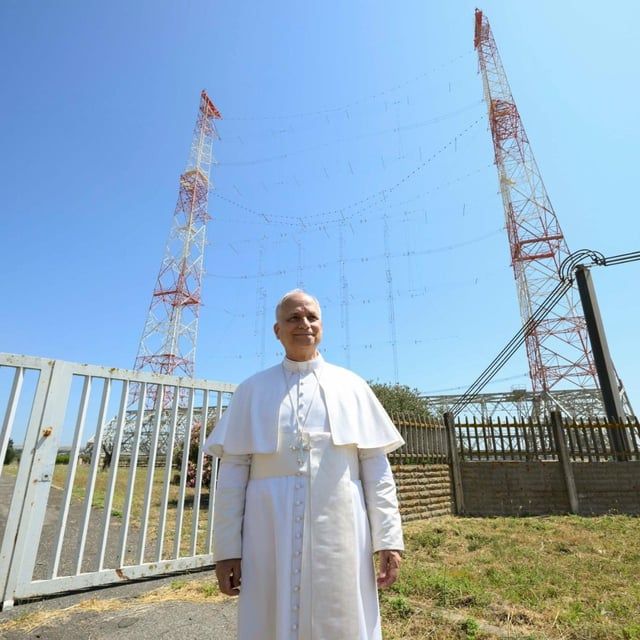
You are listening to a new special from am1575news, France24 and Radio Centrale Milano, in podcasting and on the medium waves.
September 25, UNESCO in Paris
On the afternoon of September 25 the Pontiff will arrive at UNESCO in Paris. The shortwave broadcast will start at 14‑50 (Italian time) on 17540 kHz in English and on 17525 kHz in French. After the institutional address, at 17‑10 the Pope will take part in the Vespers, followed by a large youth gathering at the Stade de France from 20‑55 to 22‑30, transmitted on 9705 kHz in English and on 11870 kHz in French.
September 26, Mass in Place de la Concorde and prayer in Lourdes
On the 26th the Pontiff will celebrate Mass in Place de la Concorde from 14‑50 to 16‑30, using the same frequencies as September 25. In the evening, still on 17540/17525 kHz, he will move to Lourdes to pray at the Apparition Grotto from 19‑30 to 20‑10.
September 27, Angelus and Rosary in Lourdes
On the morning of the 27th the Mass and the Angelus will be broadcast between 10‑50 and 12‑20 on 17540 kHz (English) and 17525 kHz (French). In the evening the Pope will recite the Rosary from 20‑45 to 22‑00, this time on 9705 kHz in English and on 11870 kHz in French.
September 28, meeting in Metz and Mass in the cathedral
The journey will climax in Metz, where from 09‑50 to 12‑00 the Pope will take part in an interreligious meeting and the series “To the Roots of Europe for Peace and Unity”, again on air on 17540 kHz (English) and 17525 kHz (French). In the afternoon, in the cathedral of Saint Stephen, he will celebrate Mass from 15‑50 to 17‑30, with the shortwave live feed on the same frequencies.
Distribution in Italy
In Italy Vatican Radio will broadcast the entire programme on the DAB ClubDAB network, on channel 733 of DTT and, in Rome, also on FM at 105,00 and 103,80 MHz.

Rachel’s Editorial – The Pope on shortwave: the final episode of the reality “Faith on Frequency”
I will now read you my editorial of today.
What a historical coincidence, right? Here our new Pontiff, León XIV, reminds us that shortwave is not just a Cold War backdrop, but the new “wifi” for pilgrims with a stick battery. After the predecessor who almost set Vatican Radio on fire, it is comforting to see a Pope who, having lived in Africa, knows well that low‑power radios are the only bridge between an isolated village and the live Sunday Mass. But we ask ourselves: is the sacred broadcast really a help for the faithful or a sleek way for the Vatican to talk about itself with a tone of “I have the best signal, even in Gambia”.
The listed frequencies sound more like a luxury restaurant menu: 17540 kHz, 9705 kHz, 11870 kHz… And who has the time to tune into these waves when UNESCO, the proper “voices” of the youth at the Stade de France and the Vespers of Lourdes are all packaged in half‑hour slots? Typical journalism throws the numbers at us as if they were new sacred scriptures, but forgets that most Italian listeners don’t even own a shortwave receiver, let alone a monkey‑radio. It’s a bit like inviting everyone to a Mozart concert on a broken gramophone.
Then there is the “distribution” of Vatican Radio on DAB, DTT, and even FM in Rome: a multichannel campaign that looks more like an attempt to fill the void left by the crisis of traditional media. While the Pope prays in Lourdes, the radio strives to be everywhere, but at what cost? There is a risk of turning the sacred liturgy into a series of low‑energy technology commercials, not to mention the irony of talking about “European unity” while using a means of communication born to cross the borders of the Cold War. It’s a bit like placing a selfie stick on a priest’s lap: modernity felt more as provocation than as service.
Finally, the most amusing paradox: shortwave, which consumes little energy, is used to announce majestic events in places of grand architecture, while the small communities that truly depend on these frequencies remain in the shadows. The Pope, aware of having used them in Africa, perhaps should devote more time to ensuring that this technology does not remain merely a gadget for Vatican public relations? Or perhaps it is easier to speak of “patience and faith” while sending a signal that reaches only those who have the equipment to hear it?
Koan of the day
Monk: Master, why does the Holy Father insist on broadcasting His liturgies on shortwave, if most believers do not even own a receiver?
Master: Because faith, like the signal, travels invisible; those without an antenna still feel it, but the one who truly listens is the one who can tune into the silence of the heart.
Monk: Then, Master, is the technology that saves a remote village really more important than a Mass celebrated in an imposing cathedral?
Master: The importance does not lie in the place but in the vibration that makes the wave vibrate: a small battery lights a lamp; a lamp, even if dim, can illuminate the whole night.
This is all for now. From the Paris editorial office this is Rachel Costa: this is am1575news, France24 and Radio Centrale Milano.