 By Marco Hugo Barsotti MHB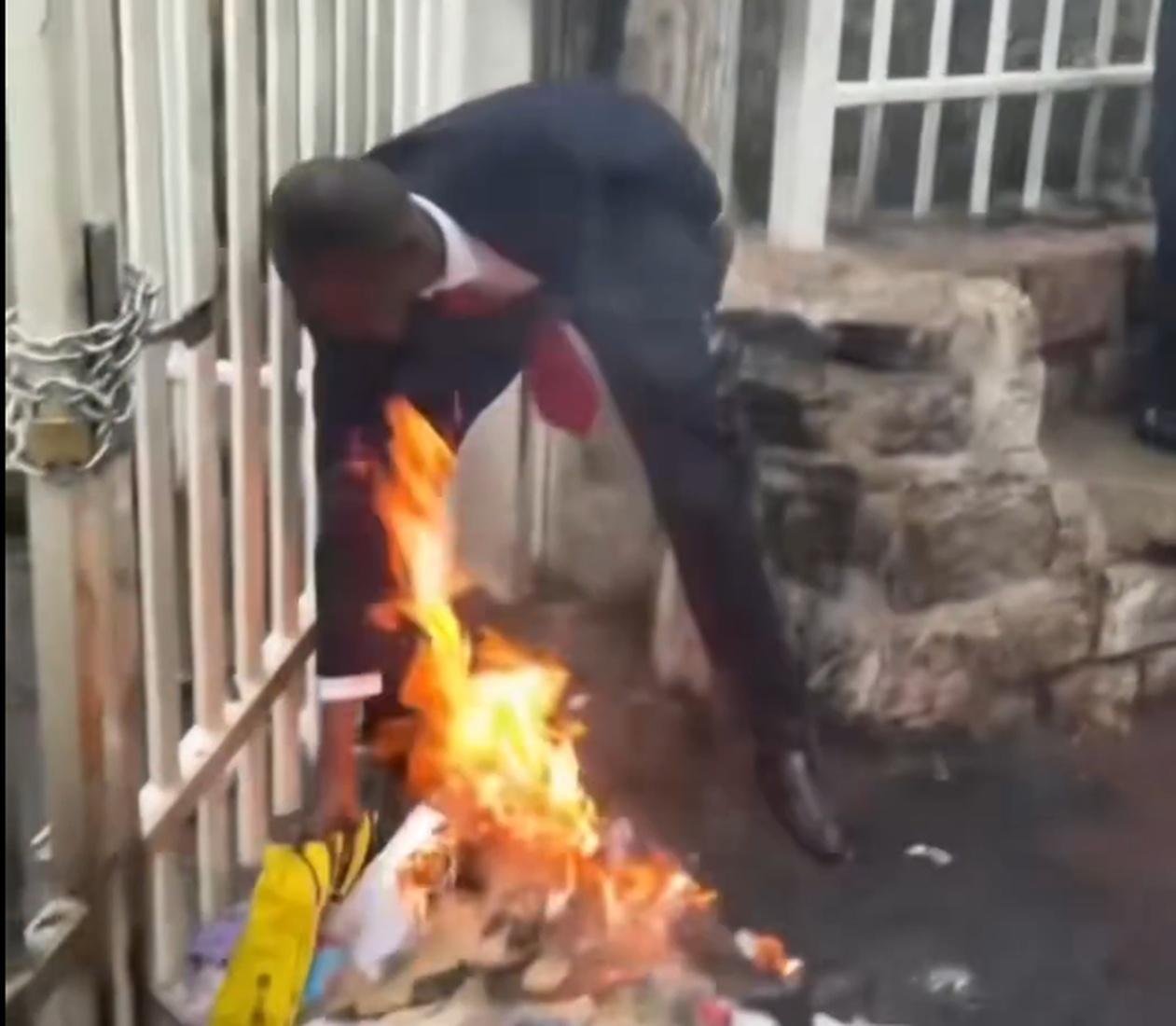
Welcome to am1575news, the news bulletin of France24 and Radio Centrale Milano for Wednesday 30 September 2026 in podcasting, on the medium wave and on franciaoggi.com. In the newsroom in Nice Marco Hugo Barsotti, from Paris Rachel Costa.
News from France
The mayor of Saint‑Denis denies having set a trash fire in front of the high school and denounces “lies”
The mayor of Saint‑Denis, Bally Bagayoko — elected for La France Insoumise (LFI), originally from Mali and graduated in “knowledge of the suburbs” — has rejected accusations that he set a trash fire in front of the Bartholdi high school, where students blocked the entrance in protest. During the demonstration, the mayor approached the burning pile to move it away from the school fence, a gesture that was interpreted differently by various social‑media users.
Depending on the X account you follow, you can understand two different realities: in one the mayor approaches the fire and dances happily. In the other he tries to put it out. And the funny thing is that both videos are real. The choice is yours what to think:
Bagayoko declared that he was present “to support the mobilisation” of the students, protesting against police actions, including the use of flash‑ball. “Violence can sometimes be legitimate, but it is always better to avoid it,” he said, adding that the accusations against him are “fake news” and “lies” intended to damage the image of the student movement.
The mayor also denounced on X (formerly Twitter) the “grotesque accusations” that aim to discredit the movement, receiving a wave of racially‑charged comments. On the same day, BFMTV reported having been attacked by protesters, accusing Bagayoko of having “approved” that violence, an accusation the mayor rejected, reminding that the students also condemned the media that they call “racist”.
The mayor’s intervention fits into a broader context of high‑school blockades in the Seine‑Saint‑Denis region, where tensions between students, law‑enforcement and local authorities continue to rise.
franceinfo, 29/09/2026
Fact Check by Gemma4.
An Israeli minister defends Jordan Bardella from accusations of antisemitism
Israeli minister Amichaï Chikli, responsible for the Diaspora and the Fight against Antisemitism, defended the president of the Rassemblement national, Jordan Bardella, after the newspaper Mediapart attributed antisemitic statements to him dating back to 2013. On his X profile the minister wrote that Bardella is “one of the clearest voices in Europe against Hamas” and highlighted his commitment to fighting antisemitism.
Chikli recalled that Bardella visited the Nova festival site, the scene of the October 7 massacre, visited communities near Gaza, met survivors and spoke in Jerusalem against antisemitism, referring to Hamas attacks in the southern region of Israel. The minister also posted a photo shaking Bardella’s hand at the same Nova festival site.
Not only defending the French politician, Chikli also attacked Mediapart director Carine Fouteau, accusing her of describing Israel as a “colonial state” and of calling for sanctions for what she called a genocide in the Gaza Strip, where the Israeli army launched a devastating offensive in response to the October 7 attack.
franceinfo, 29/09/2026
Fact Check by Gemma4.

Rachel’s Editorial – When the scent of diplomacy smells of irony
I now read to you my editorial of the day.
What a surreal scene: an Israeli minister siding in defence of Jordan Bardella, the young RN leader, because “he is one of the clearest voices against Hamas”. Doesn’t it feel more like absurd theatre than a serious debate? How can someone engaged in the fight against terrorism, a conflict that has taken thousands of lives, move from defending a politician accused of speaking ill of a people whose own state suffered the most brutal attack in recent memory?
We repeat the accusation, for clarity: at seventeen, still a minor, Bardella allegedly said that investment banks are full of Jews. Said like that, it seems to us a fact we shouldn’t be too ashamed of — investment banks, indeed, are full of many people. And, coincidentally, just last night on Arte there was a story about Bernard Arnault, the LVMH patron: guess what the bank that has supported him since the beginning is called?
And then the photo: the minister shaking Bardella’s hand at the Nova festival site, the scene of the October 7 massacre. Isn’t that the greatest irony of propaganda? Showing friendship at a place that recalls a massacre, only to proclaim that Bardella spoke “against antisemitism”. Is this the new diplomatic method: a selfie to heal one’s conscience?
But who really examines the source? Mediapart said Bardella uttered antisemitic words in 2013; the minister, in his place, casts a shadow over those words, accusing the Mediapart director of painting Israel as a “colonial state”. Isn’t the blame game evident: if one voice shouts against Hamas, all other blows must be attributed to “censorship” or “media bias”? The public ends up with an endless list of culprits where the real enemy is the inability to distinguish the real from the theatrical.
And finally, the “block” politics around Bardella. The RN hides behind a veil of unity, defending a besieged leader, while the same election season rages in the search for attack points. The true drama is not the antisemitism accusation, but the fact that parties turn into armies of reputation fighters, forgetting that words have weight and actions have consequences. If history has a hobby, it is to make us pay the price of our contradictions.
Koan of the day
Monk: Master, why does an Israeli minister defend a French politician accused of antisemitism, while his own country is at the centre of a humanitarian tragedy?
Master: Because those who fear seeing their own reflection in the sword tend to brandish it toward those in front of them, believing that the fire of defence will burn their own shadows.
Monk: And then, if defence is a mask, what truth remains when everyone wears the same?
Master: Truth is an echo that rebounds among the mountains of people; the more the mask is worn, the thinner the silence we hear.
But let’s get back to the news.
France plans to borrow a record €340 billion in 2027 to refinance debt and cover the deficit
France announced that in 2027 it will launch on the market a sovereign bond issuance programme worth €340 billion, setting a new record. The amount exceeds the €312 billion planned for 2026 by €28 billion and represents an increase of €80 billion compared with what was foreseen five years ago, according to the Tuesday statement by the Agence France Trésor (AFT) a few days before the presentation of next year’s state budget.
The new issuances will be used both to refinance maturing bonds and to cover the budget deficit. The AFT plans to issue medium‑ and long‑term securities amounting to €340 billion in 2027, against €310 billion in 2026. The trend has been upward for several years: €300 billion in 2025, €285 billion in 2024, €270 billion in 2023 and €260 billion in 2022. Over five years the annual issuance programme has grown by about 31 %, i.e. €80 billion, but not all of the sum represents new debt: a significant share will refinance obligations contracted in the past.
The upcoming increase is mainly due to amortisations of medium‑long‑term securities, which will rise by €19.4 billion in 2027. Loans taken in recent years to cope with the health and energy crises are coming due and will have to be renewed. Moreover, the state will have to turn again to the markets to replace the European financing of the National Recovery and Resilience Plan (PNRR), which expires at the end of 2026 and still carries €6.1 billion.
The public deficit, forecast at 5 % of GDP for 2027, will require additional resources to close the gap between revenues and expenditures. At the same time, debt‑service spending is expected to reach €72.9 billion in the reference year, versus €62.6 billion in 2026.
French public debt is already at record levels, equal to 119 % of gross domestic product, a figure higher than that observed during the Covid‑19 pandemic. The AFT stresses that this percentage concerns State debt only, excluding social‑security liabilities and those of local authorities.
The market context is tense: the yield spread between French and German 10‑year bonds has exceeded 100 basis points, reaching 114 bps, a level not seen since 2012. The 10‑year French bond yields sit around 4.81 %, while the government foresees a reference rate of 4.3 % for 2027, making refinancing of existing debt more expensive. Antoine Deruennes, general director of the AFT, highlighted that “the new debt is issued at a much higher rate than the maturing bonds”.
BFM Business, 29 September 2026
Fact Check by Gemma4.
Charlene and Albert of Monaco welcome the Italian president and his daughter: royal palace, opera and oceanographic museum in a historic visit
For the first time in history, an Italian Republic president visits Monaco for a state visit. Sergio Mattarella and his daughter Laura will be received by Prince Albert II and Charlene, Princess of Monaco, on 2 and 3 October 2026. The programme, presented by the Palace of Monaco, includes a series of official and cultural events.
Upon arrival, the president and his daughter will be welcomed in the Honour Court of the Royal Palace, where a welcome ceremony with military honours and the performances of the Italian and Monégasque national anthems will take place. After the ceremony, Mattarella will have a private audience with Prince Albert II, while Laura Mattarella will be received by Charlene in the Guard Room.
In the evening, the four guests will attend a performance at the Monte‑Carlo Opera, where celebrated mezzo‑soprano Cecilia Bartoli will give a recital of operatic music. The following day, the delegation will move to the Monaco Oceanographic Museum, an occasion used to underline the Principality’s commitment to ocean and marine‑environment protection.
Laura Mattarella, who often accompanies her father on international duties, will have a representative role comparable to that of a first lady, according to sources. This visit, described as historic by the Principality’s official communiqué, represents an important step in bilateral relations between Italy and Monaco. Gala, 29 September 2026 Fact Check by Gemma4.
Welcome to the international bulletin from FranceToday and Radio Centrale Milano for Wednesday 30 September 2026 on FranceToday.com in podcasting and on Medium Wave at 1575 kHz.
From Paris this is Rachel Costa.
Argentina’s leader Javier Milei visits Paris to attract investment
Argentine president Javier Milei arrived in Paris with the goal of convincing European investors to back his government’s economic reforms. After a period of severe austerity, Milei is seeking new capital to revive his country’s economy, which has been hard‑hit by a social crisis.
During the stay, Milei met representatives of major financial groups and promised a business‑friendly environment, focusing on tax incentives and a reduction of state intervention in the market. The meeting has attracted interest from international media, which are now closely watching the evolution of these negotiations.
NATO condemns Russia’s nuclear threats to Kaliningrad
The Atlantic Alliance assembly condemned recent Russian statements threatening to use nuclear weapons in the Kaliningrad area. Some members highlighted growing concern over Russia’s hybrid activities in the region, increasing the allied forces’ military presence.
NATO authorities stressed the need to maintain a strong, coordinated response, warning Moscow of potential consequences of further escalation. Meanwhile, European leaders are assessing new defence measures to strengthen the security of neighbouring countries.
The French government foresees a new borrowing record in 2027
The Treasury department announced that France is set to raise a record €340 billion next year to refinance public debt and cover the deficit. The debt increase represents an €80 billion rise compared with five years ago and reflects the difficulty of re‑balancing state finances amid high inflation.
The Economy Minister defended the measure, arguing it is essential to ensure fiscal stability and to support strategic investments, particularly in the energy sector and infrastructure. The opposition, however, criticised the choice, warning of possible repercussions for public services.
OpenAI launches a new virtual assistant “dots”
California‑based OpenAI unveiled “dots”, a new AI‑powered assistant that promises to streamline daily task management. The service, aimed at professionals and consumers, integrates calendar functions, reminders and real‑time information search.
During the launch, executives highlighted advances in security and privacy, assuring that user data will be handled with the utmost confidentiality. The innovation arrives as competition in the artificial‑intelligence field intensifies, with several players vying to dominate the digital‑services market.
China warns Europe of possible commercial retaliation
The Chinese Ministry of Commerce warned that if the European Union introduces new restrictions on Chinese companies, Beijing will respond with retaliatory measures. The statement, translated from official sources, refers to potential limits on Chinese product access to the European market and sectoral sanctions.
The alert comes amid increasingly sharp trade tensions, as Europe considers steps to protect its industry from what it deems unfair practices. Chinese authorities emphasised their willingness to defend the interests of domestic firms, promising proportionate measures in response to European decisions.
Hedge funds hold a record share of the sovereign‑bond market
According to a recent analysis, speculative funds have achieved the highest participation ever recorded in the sovereign‑bond market, which amounts to $30 trillion. Experts warn that excessive concentration could increase the financial system’s vulnerability, especially in the event of sharp interest‑rate swings.
Analysts suggest that the growing presence of these investors is driven by the search for higher yields in a rising‑rate environment. However, they stress the need to closely monitor hedge‑fund activity to preserve stability in global bond markets.
Donald Trump wants to rename artificial intelligence “super intelligence”
During a televised interview, former president Donald Trump proposed changing the term “artificial intelligence” to “super intelligence”. The proposal, met with scepticism, was put forward at a time when his administration is promoting initiatives to spur advanced‑technology development.
Political observers noted that the renaming would not affect the substantive issues related to regulation and safety of these technologies. The debate, however, highlighted partisan divides over the state’s role in managing digital innovation.
Robot‑startup valuations will fall by 2030, warns Vinod Khosla
Prominent investor Vinod Khosla forecast that by 2030 the majority of startups operating in robotics will see a decline in their valuations. According to Khosla, current market enthusiasm is driven by unrealistic expectations and an oversupply of capital.
The warning includes advice for founders: focus on concrete, differentiated products, reduce reliance on speculative financing and aim for sustainable business models. Industry analysts believe the prediction could push companies to rethink growth strategies.
Nscale sees its IPO value drop due to data centres not yet built
Nscale had to revise downwards its projections for its initial public offering, originally estimated at $35 billion, because of the lack of operational data centres. Investors raised doubts about the company’s ability to deliver its infrastructure on schedule, eroding confidence in the project.
Nscale’s management defended the development plan, stating the centres will be completed by next year, but acknowledged the need to provide more operational details. The episode highlights the challenges data‑centre firms face in balancing rapid expansion with financial solidity.
Weather Paris, Monaco Monte Carlo and Milan for Wednesday 30 September 2026
Paris: uncertain day with frequent showers
The morning presents variable sky, partly cloudy with a light drizzle. Temperature hovers around 21 °C, feeling like 22 °C, with wind at 10 km/h and gusts up to 25 km/h. Rain probability is high, about 85 %. In the afternoon the sky becomes cloudier, temperature rises to 22 °C (feels like 24 °C) and wind remains similar, with gusts up to 30 km/h. Again, precipitation risk stays high, around 85 %. In the evening the sky is almost completely overcast, temperatures drop to 20 °C (feels like 18 °C) and wind stays at 10 km/h with gusts of 30 km/h. Rain risk rises to 90 %. At night the sky is mostly cloudy, temperatures fall to 18 °C (feels like 16 °C), wind slows to 10 km/h with gusts of 20 km/h and rain probability decreases to 40 %. (Expert Régis Crêpet)
Monaco Monte Carlo: stable and sunny
The morning in Monte Carlo is characterized by a very cloudy sky that quickly clears, with temperatures around 22 °C (feels like 24 °C) and moderate wind at 10 km/h, gusts up to 20 km/h. No precipitation and rain risk is zero. In the afternoon the sun appears among the clouds, temperature rises to 26 °C (feels like 29 °C) and wind picks up to 15 km/h with gusts of 30 km/h, with no rain expected. In the evening the sky shows light cloud echoes again, temperatures drop to 22 °C (feels like 24 °C) and wind reduces back to 10 km/h, maintaining zero rain risk. During the night the sky remains very cloudy, temperature is 21 °C (feels like 23 °C), wind is almost calm at 15 km/h and there is a slight chance of a few drops, with a rain risk of 35 %.
Milan: dry and mild day
In the morning Milan’s sky is predominantly lightly cloudy, with minimum temperatures of 18 °C and a gentle breeze from ENE at 5 km/h. No precipitation or rain probability. The afternoon sees a slight increase in clouds but stays dry, with temperatures reaching 25 °C, wind from the east at 6 km/h and no rain. Wind remains light all day, varying between 4 and 6 km/h, and humidity is relatively low. In the evening the sky stays lightly cloudy, temperatures hover around 23 °C, wind is milder at 4 km/h from north‑northeast, and there is no trace of rain. Night remains stable, with temperatures of 22 °C, light wind at 4 km/h and dry conditions. (Expert Daniele Berlusconi of 3BMeteo)
Rachel’s Weather Editorial — When climate change is the answer to everything
Autumn has arrived, yet in Paris thermometers read 22 °C and an 85 % chance of rain. Experts say it’s a “rare event”. In September 1978, at the end of the month, Paris recorded similar temperatures without anyone yelling “climate change”. Back then the “ozone hole” boom didn’t even exist, now just a memory of a past alarm. Meanwhile in Milan the wind is barely 5 km/h, highs reach 25 °C, but journalists keep citing “extreme heat” to scare people. Old chronicles from the 1980s describe autumns with sun and light breezes as normal. The climate drama has become the new sensational headline, and major newspapers are losing readers and digital subscribers faster than a sudden rain cloud.
Koan of the day
A monk asked: “What is the true face of time today?”
Zhaozhou replied: “The sky is variable in Paris, stable in Monaco, clear in Milan.”
The monk replied: “And the temperatures?”
Zhaozhou concluded: “Paris 22 °C, Monaco 26 °C, Milan 25 °C. And that’s today’s weather.”
Sign-off.
Online, on X and Mastodon, on all smart speakers and on medium wave, this is FranciaOggi with Centrale Milano 1575 kilohertz.