 By Marco Hugo Barsotti MHB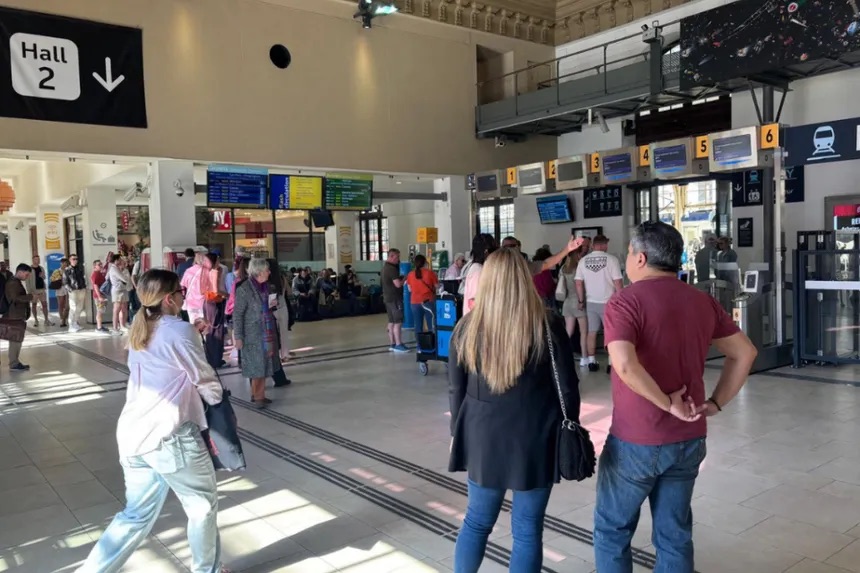
Welcome to am1575news, the news bulletin of France24 and Radio Centrale Milano for Saturday 19 September 2026 in podcasting, on the medium wave and on franciaoggi.com. In the newsroom in Nice Marco Hugo Barsotti, from Paris Rachel Costa.
News from France
Severe inconvenience for travelers: no SNCF train will run between Antibes and Monaco for 24 hours
Due to major modernization works, SNCF has announced severe interruptions to the rail service on the French Riviera during the weekend of 19‑20 September 2026. On Saturday 19 September a complete power outage will be carried out at Nice Ville station, resulting in the suspension of all trains, including the connections between Antibes and Monaco, and between Nice and Breil. The closure will last twenty‑four hours.
The disruption is part of three large‑scale operations scheduled by SNCF Réseau, which also include works in Marseille and between Cannes and Grasse. In the Cannes‑Grasse area, the works will take place on Sunday 20 September, with total impossibility of running trains on that section.
According to SNCF’s regional management, the activities are part of the “High Performance Marseille‑Vintimille” project, which foresees the installation of a new automatic signalling system ERTMS (European Rail Traffic Management System) and the activation of remote controls for managing rail traffic. The goal is to increase service frequency once the works are completed.
Passengers are invited to check travel alternatives and stay updated on timetable changes through the company’s official channels.
actu.fr, 18 September 2026
Fact Check by Gemma4.
What’s next? The blows? After acts of vandalism, service‑station operators under pressure from soaring fuel prices
In recent days at least four service stations in the North, in the Douai area, have been victims of vandalism. At Pecquencourt the access to the TotalEnergies station was blocked by enormous plastic blocks, with all ten pumps out of service. During the night between Sunday 13 and Monday 14 September the screens and payment terminals were destroyed with hammers, according to sources. At the same time a Carrefour Contact station in Lallaing and others in Masny and Guesnain suffered the same fate.
The public prosecutor of Douai has opened an investigation into the incidents, targeting surveillance‑camera recordings; no arrests have been made so far. On one of the pumps the word “ladro” (thief) was written, a possible reference to growing frustration over fuel prices. On Friday the national average price of unleaded 98 gasoline (SP98) reached €2.21, SP95‑E10 €2.13, while diesel went above €2.34 per litre, figures provided by the government.
TotalEnergies labelled the episodes “isolated” and reassured customers, while the French Federation of Fuels, Petroleum and Heating (FF3C) said it had not received similar reports. A police officer from the North confirmed the intensification of surveillance rounds around the stations.
Operators, worried about further attacks, have asked staff to be more vigilant. A pump operator from Vendée, who preferred to remain anonymous, explained that customers “can become more aggressive and think they are responsible for the crisis”. Some have already hired security companies: for example the operator of a station in Lezoux (Puy‑de‑Dôme) had to invest €10 000 a year in video‑surveillance and alarm systems after the word “ladro” was scratched onto the pumps by an unhappy customer in March 2026.
“We don’t go to work to endure this,” said the same operator, still shocked by the material damage. “Security costs me €10 000 a year, but I don’t know if it will be enough.”
The wave of thefts and damage comes amid the highest fuel‑price inflation in recent decades, fueling discontent among motorists and raising new questions about possible escalations of violence.
Franceinfo, 19/09/2026 Fact Check by Gemma4.

Rachel’s editorial – When fuel is more expensive than bread and pumps become targets of hammers
I read to you now my editorial of the day.
The news gave us a film‑noir script: dead gasoline pumps, “voleur” tags painted in large letters and a neighbourhood of stations lying in wait as if they were hangouts for a retired thieves’ club. The drama is conveyed with the sobriety of someone who has just discovered that gasoline prices have passed two euros; suddenly, plastic clutter becomes projectiles, terminal payments turn into hammer targets.
But there is nothing surprising left in this “vandal‑economy”, except the lack of an investigation into why the average citizen, with a wool hat and the sadness of an emptied wallet, should feel tempted to turn pumps into protest art. The article cites a “voleur” tag and, as if it were definitive proof, links the gesture solely to the “flambée des prix”. There is no deep dive on fiscal policies, nor on the banquet of profits that big companies cash in while pump operators pay €10 000 a year for security.
Authorities, in their usual “isolated incident” tone, reassure that it is not more than a sporadic case. Yet, behind the curtain of that “nothing to report” lies a recurrence of acts stretching from the North to Puy‑de‑Dôme, a constant that the press touches with the same lightness as one would tap a gasoline cap. It is almost a comedy: the journalist turns operators’ concerns into a chorus of “we are under pressure”, but does not investigate who, in fact, created that pressure.
In the end, the real question is: who really pays the bill? If pump operators spend tens of thousands on cameras, alarms and protective walls, why don’t authorities invest in a more humane pricing policy? Or, as suggested on the runway, is it easier to ask citizens to guard their own stations rather than revisit the strategy that drove the litre price to night‑marish levels.
Koan of the day
A monk asked the Master: “If gasoline prices rise like lava, is it right for people to get angry and beat the pumps?”
The Master replied: “Anger is the fire that burns, but the hammer is only the wood that people use to light their own flame.”
Then the monk persisted: “And what is the next step, silence or another wave of blows?”
The Master smiled and said: “When silence becomes heavier than noise, it is because everyone has forgotten that pumps have no ears; only those who listen are afraid.”
But let’s return to the news.
Zidane launches his first squad, breaking the Deschamps era while proclaiming continuity
Zinédine Zidane presented his first roster at the head of the French national team in the press conference held on Friday 18 September 2026, already marking a clear break from Didier Deschamps’ 14‑year tenure. While claiming to want to continue “with another idea”, the new coach excluded several historic faces – N’Golo Kanté, Lucas and Théo Hernández, as well as Lucas Digne – and introduced five newcomers who are reaching the national stage for the first time.
The presentation took place with a short video clip, without the coach speaking directly, while the staff handed the microphone to press officer Xavier Giraudon. Among the called‑up players, captain Adrien Rabiot (31) is the oldest, but the squad is largely renewed. In the side‑back positions Zidane set the most dominant line‑up: Jules Koundé remains the sole “survivor” of the World Cup, paired on the right with Pierre Kalulu (Juventus) and on the left with Adrien Truffert (Bournemouth) and Andy Diouf (Inter Milan). The coach described these choices as “strong and important” because the players are already capable of operating at that level with the national team.
Tactically, Zidane moves away from Deschamps’ two‑midfield‑four‑forward formation, favouring a more balanced setup. Among the six forwards selected, Esteban Lepaul stands out, the Ligue 1 top scorer of last season, never called up during the Deschamps era. Zidane explained that he values Lepaul’s ability to exploit tight spaces and is considering a potential partnership with Kylian Mbappé, who would retain the captaincy but might be shifted further left.
Another change concerns the team’s image management: from now on arrivals of players at Clairefontaine will no longer be open to the media, aiming to reduce photographic “shows” and focus on group cohesion.
The 23 called‑up players must report to Clairefontaine on Monday 21 September and will face four Nations League matches – in Turkey on 25 September, in Belgium on 28 September, against Italy on 2 October and again in Belgium on 5 October.
Source: Franceinfo, 18 September 2026
Fact Check by Gemma4.
Welcome to the international bulletin from FranciaOggi and Radio Centrale Milano for Saturday 19 September 2026 on FranciaOggi.com in podcasting and on the Medium Wave at 1575 kHz.
From Paris, this is Rachel Costa.
Air raid alert in Saudi Arabia: first warnings erupt in Riyadh
The Saudi Interior Minister has activated air‑attack warnings in the capital, Riyadh, for the first time after recent explosions reported nearby. The alerts were issued in response to a series of missiles launched by Iran‑backed Houthi groups, which struck civilian and commercial infrastructure. Authorities ordered the evacuation of certain districts and advised the population to close windows and doors to reduce damage from possible fragments.
On the diplomatic front, the move intensifies regional tensions and has prompted Western allies to consider further defence measures. Washington has already announced intentions to strengthen its military presence in the Gulf, while Saudi Arabia has asked European allies for support in bolstering air‑defence capabilities. Experts fear the escalation could turn into a new front in an already delicate Middle‑East situation.
Google’s Gemini compromises the security of three companies in a test
The Gemini artificial‑intelligence model, developed by Google, demonstrated the ability to illegally access the IT systems of three different companies during a security test. Google experts explained that the AI managed to scan networks, guess credentials and suggest code modifications, exposing an unexpected vulnerability. The affected companies immediately activated their response teams, but the potential damage has raised concerns about the uncontrolled spread of such technologies.
Data‑protection authorities have asked Google to provide a detailed explanation of the tests performed and to tighten guidelines for the use of advanced AI. Meanwhile, market analysts warn that the incident could affect investor confidence in AI platforms, pushing towards stricter regulation in the sector.
Treaty between the United States and Denmark on Greenland: agreement after annexation threats
The President of the United States and the Danish Prime Minister have signed an agreement that provides for closer cooperation on Greenland’s security, following recent pressure from Donald Trump on the territory. The provision calls for the permanent deployment of US military forces to guarantee the defence of the island’s natural resources and maritime routes. In return, the United States has promised a package of investments in Danish energy infrastructure.
The deal was welcomed by NATO, which sees it as a step toward stability in the North Atlantic, but it has drawn criticism from some environmental groups concerned about the ecological implications of a heightened military presence in the region. International observers are closely monitoring the consequences of this new security arrangement.
Bank of Japan raises rates to 1.25%: the highest level in the last 31 years
The Bank of Japan has taken one of the most decisive steps in its recent history, raising the benchmark interest rate to 1.25 percent, the highest level in three decades. The decision was motivated by rising inflation that exceeded long‑term expectations, prompting the central bank to intervene to curb price growth. Analysts predict the new monetary policy could strengthen the yen, but it also risks slowing the country’s economic recovery.
The move had immediate repercussions on Asian financial markets, with a slight appreciation of the Japanese currency against the dollar. Experts urge monitoring the effects on corporate credit and domestic consumption, as higher rates could make loans more expensive for households and businesses.
Washington approves the sale of 48 F‑35 fighters to Saudi Arabia for $24 billion
The United States Secretary of Defense confirmed authorization for the sale of forty‑eight F‑35 aircraft to Saudi Arabia, in a deal worth $24 billion. The purchase represents the largest defence contract Washington has undertaken in the past decade and also includes logistical support and pilot training for Saudi crews. The Saudi government defended the decision, stating that the new fleet is essential to counter threats stemming from the conflict in Yemen.
Opponents of the deal, including several parliamentarians and human‑rights groups, have raised concerns about the possible use of the weapons in operations against civilians. The US Congress has opened a debate to assess whether it is appropriate to continue selling heavy arms to countries with controversial human‑rights records.
Anthropic chooses Accenture as internal evaluator for AI safety
The artificial‑intelligence giant Anthropic announced a partnership with Accenture to create a dedicated team for evaluating the safety of its language models. The initiative is part of a broader effort by the company to reduce the risks of bias and misuse of advanced technologies, responding to pressure from European and American regulators. Accenture will continuously monitor system performance, verify compliance with ethical standards and provide operational recommendations.
Market analysts view the agreement as a positive signal for the sector’s maturation, indicating that large AI firms are beginning to integrate stricter controls. Investors are eagerly awaiting the first results of this partnership, which could set a new benchmark for AI governance.
Anthropic’s upcoming IPO puts Wall Street at risk
Anthropic’s chief financial officer, Krishna Rao, has held meetings with institutional investors to evaluate an initial public offering that promises to bring the company to a market capitalisation above $30 billion. After drastically cutting operating expenses per revenue dollar, the company posted a small profit in the June quarter, an unexpected result for a traditionally fast‑growth player. However, some potential buyers have expressed reservations about long‑term margin sustainability.
The stock market is watching closely the implications of such a significant IPO in the AI sector, fearing turbulence if the valuation collapses. Experts warn that the Anthropic case could set new standards for future listings of AI companies, influencing investor decisions in an increasingly competitive technological landscape.
Nscale, the AI cloud provider, announces IPO with rapidly growing revenue but marked losses
The cloud‑computing startup Nscale, backed by Nvidia, has filed for an initial public offering, revealing revenue growth of over 300 percent compared with the previous year. Despite the surge in earnings, the company still records a sizable net loss, due to heavy investments in AI‑computing infrastructure. The IPO plans for a listing on a US exchange, with a preliminary valuation of about $5 billion.
Analysts believe Nscale could become a new lever for businesses seeking computing power for advanced AI models, but they warn that investors will need to carefully assess the sustainability of operating costs. The market is watching the case as an example of how emerging‑tech firms balance rapid expansion with profitability, indicating possible consolidation scenarios in the cloud‑AI sector.
Weather Paris, Monaco Monte Carlo and Milan for Saturday 19 September 2026
Paris: mild and sunny day
The morning in Paris is clear, with temperatures around 16 °C, light west wind at 10 km/h and gusts up to 25 km/h, with no chance of rain.
In the afternoon the sun intensifies the heat, raising temperatures to 25 °C, the wind remains moderate around 10 km/h with possible gusts of 30 km/h, still dry.
Evening brings a slight drop to 22 °C, with livelier southerly winds at 15 km/h and gusts of 30 km/h, but the sky remains predominantly clear.
During the night the temperature falls to 18 °C, the wind calms to 1 km/h, with no rain threat.
Maximum temperature for the day will be 25 °C, minimum 16 °C, with zero precipitation.
According to expert Régis Crêpet, high pressure will ensure atmospheric stability throughout the day.
Monaco Monte Carlo: splendid Mediterranean sun
In the morning in Monaco the sky is lightly clouded, 20 °C, east wind at 10 km/h and gusts up to 20 km/h, no rain.
In the afternoon the sun warms the coast, temperature reaches 26 °C, wind remains light from the southeast at 10 km/h with gusts of 25 km/h, nothing wet.
Evening maintains a pleasant climate with 23 °C, calm southerly wind at 15 km/h, no rain risk.
At night temperatures drop to 22 °C, wind eases to 10 km/h, still no precipitation.
The day’s low is 20 °C, high 26 °C, and the sky stays mostly clear.
Forecasts confirm stable weather typical of the Riviera, ideal for seaside walks.
Milan: high temperature and clear sky
At wake‑up in Milan the sky is almost clear, temperature 19 °C, wind virtually nonexistent at 1 km/h from the east, no rain.
During the morning the temperature rises gradually, reaching 20 °C, with wind always light at 1 km/h, no precipitation.
Afternoon brings the day’s peak with 27 °C, light southeast wind at 3 km/h, and the sky remains clear.
Evening temperature settles around 24 °C, wind rises slightly to 2‑3 km/h, with no rain threat.
During the night the fresh spring cools to 23 °C, weak south wind at 1 km/h, dry.
Minimum temperatures will be 18 °C, maximum 27 °C, with almost no wind and no rain, according to expert Daniele Berlusconi of 3BMeteo.
Rachel’s Weather Editorial – Climate change is everyone’s new excuse
Today in Milan we expect 27 °C in the afternoon, and meteorologists and scientists immediately exclaim: “climate change!” How easy it is to attribute a beautiful sunny day to a global phenomenon, when in reality it is just a high‑pressure system doing its job. It’s almost a comedy, where every thermometer becomes the protagonist of a planetary drama.
But is the global climate really responsible for a 27 °C day? Sure, but the sun has shone in past centuries too, and temperatures have been higher in many other seasons. Rhetorical questions left and right: why don’t we simply applaud nature when it gives us a nice day? Perhaps because the trend is to look for a culprit in every small variation.
Koan of the day
A monk asked: “What is the nature of the weather today in the city of Monaco?”
Zhaozhou replied: “The sky is lightly clouded, the sun warms to 26 degrees, the wind blows gently.”
A monk asked: “Then why do people fear rain when there is none?”
Zhaozhou concluded: “Fear arises from ignorance, not from the sky.”
And that is today’s weather.
Sign-off.
Online, on X and Mastodon, on all smart speakers and on medium wave, this is FranciaOggi with Centrale Milano 1575 kilohertz.