 By Marco Hugo Barsotti MHB
You are listening to a new special from am1575news, Francia24 and Radio Centrale Milano, in podcasting and on medium wave.
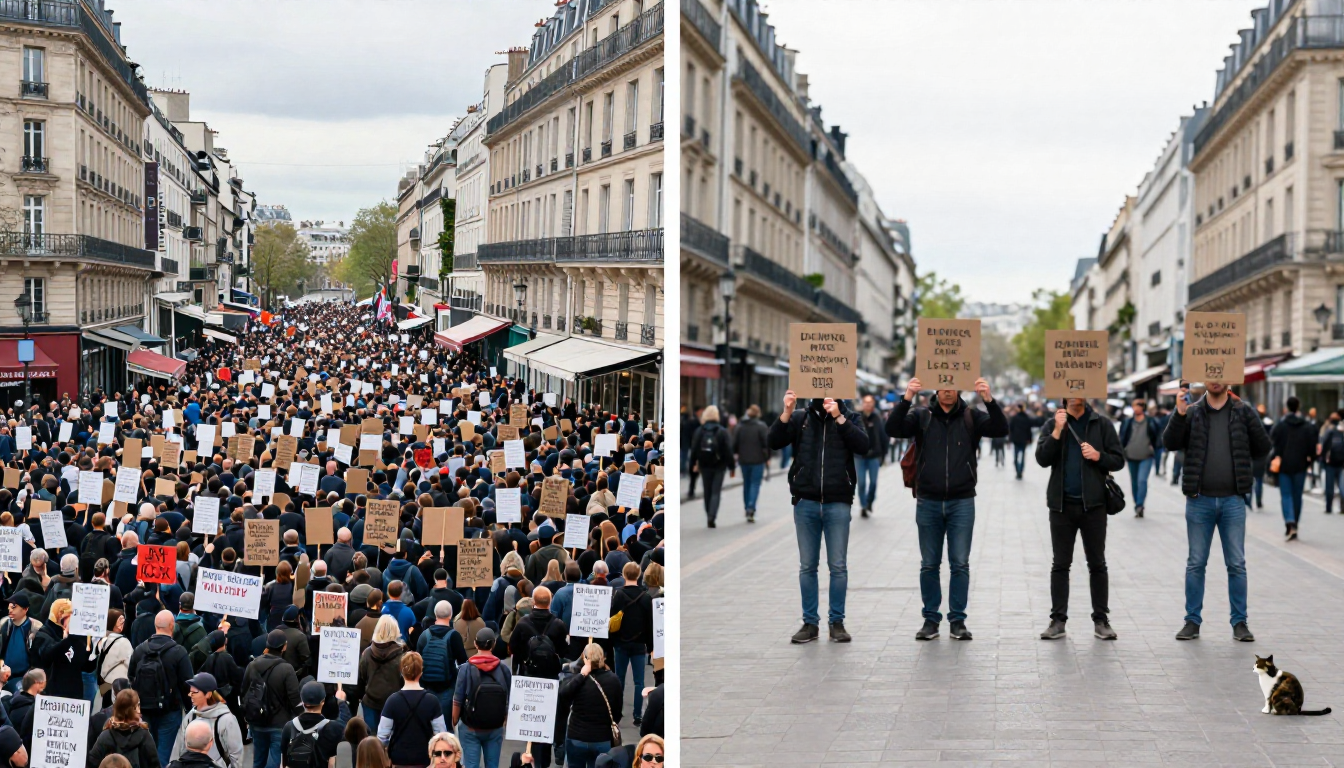
Great differences yesterday, as always, in the calculation of the number of participants in the demonstrations. Yesterday in particular, there was almost a million difference between the union estimate and that of the government. But how are these participants calculated? This is our complete analysis.
In France, when talking about demonstrations (manifestations), three things must be distinguished:
- The number of people actually present at a given moment.
- The total number of people who participated during the course of the march.
- The number declared by organizations, which is often an aggregate estimate of various demonstrations across the national territory.
They are not necessarily the same thing.
1. How the police count (Ministry of the Interior)
The French method is relatively sophisticated, especially in Paris.
The police primarily use:
- Observers positioned in elevated points, along the route of the march.
- Manual counting of people crossing certain points, often counting rows.
- Video recordings of the passage of the demonstration.
- A second count, carried out later in the office, reviewing the recordings.
- Comparison between different counts to produce a final estimate.
This methodology was examined in 2015 by an independent commission chaired by Dominique Schnapper, which substantially validated its approach.
The advantage is that it seeks to count the people who actually pass through, avoiding simply estimating how full a street is.
2. How the unions count
Here the method is less transparent.
The CGT, for example, uses several sources:
- Counters placed at passing points of the march.
- Information collected from its own local and departmental sections.
- Estimates from territorial organizations, subsequently transmitted to the national leadership.
- In some cases, information on buses and trains organized to bring protesters.
The problem is that a sufficiently detailed methodology is not published to verify how duplications are eliminated.
For example: if a person arrives by train, joins the march, walks half of it, and then leaves the demonstration, are they counted only once? And how is this verified?
It is not always possible to know.
3. Is there an independent method?
Yes. For a few years, a group of about 80 French news outlets funded the work of a specialized company, Occurrence.
The system is interesting:
- The march is filmed.
- A virtual line is defined on the route.
- Video analysis software, using artificial intelligence, counts the people who cross that line.
- This results in a count of the passages.
In 2017, the method was verified by filming an entire demonstration and having the images manually recounted by four independent groups: Occurrence, Europe 1, TF1, and Le Monde. The results were very close.
However, the project failed to become a universally accepted arbiter: unions and left-wing parties have often contested the results.
4. The concrete case: demonstration of November 5, 2026
A clarification: the final data published by Le Monde are these:
National participation
| Source | Participants |
|---|---|
| CGT | 1,573,000 |
| Ministry of the Interior | 575,000 |
In Paris
| Source | Participants |
|---|---|
| CGT | 350,000 |
| Prefecture | 65,000 |
(Difference of 2.74 times)
Source: Le Monde, November 5, 2026.
5. But who is right?
Here we arrive at the most interesting question.
An important datum emerges from the analysis of the statistician Jean-François Royer, published in The Conversation:
The differences between the two methods are not sufficient to explain such enormous gaps.
In other words, it is not reasonable to think that the difference between 575,000 and 1,573,000 is simply due to some technical counting error.
There are also two opposing interests:
- The unions have an interest in proving that the mobilization is massive, because this strengthens their negotiating and political weight.
- The government has an interest in not emphasizing the scale of the protest, because a highly attended movement represents a political problem.
Caution: this does not prove that the Ministry systematically manipulates the data. The police methodology has undergone independent verification and has a serious statistical basis.
My conclusion: if I had to choose a figure to publish in a journalistic article, I would give both estimates, without calculating the arithmetic mean.
And above all, I would ask one thing that is rarely done: why not adopt a national independent system, based on video footage, automated counting, and public methodology?
It would be technically feasible and would take away the monopoly of the battle of numbers from both the unions and the government.
This is all for now. From the newsrooms of Nice and Paris, this is am1575news, Francia24 and Radio Centrale Milano.
Source: AudioVisione – AM 1575 News