 By Marco Hugo Barsotti MHB
You are listening to a new special from am1575news, France24 and Radio Centrale Milano, in podcasting and on the medium waves.
Friday evening disaster
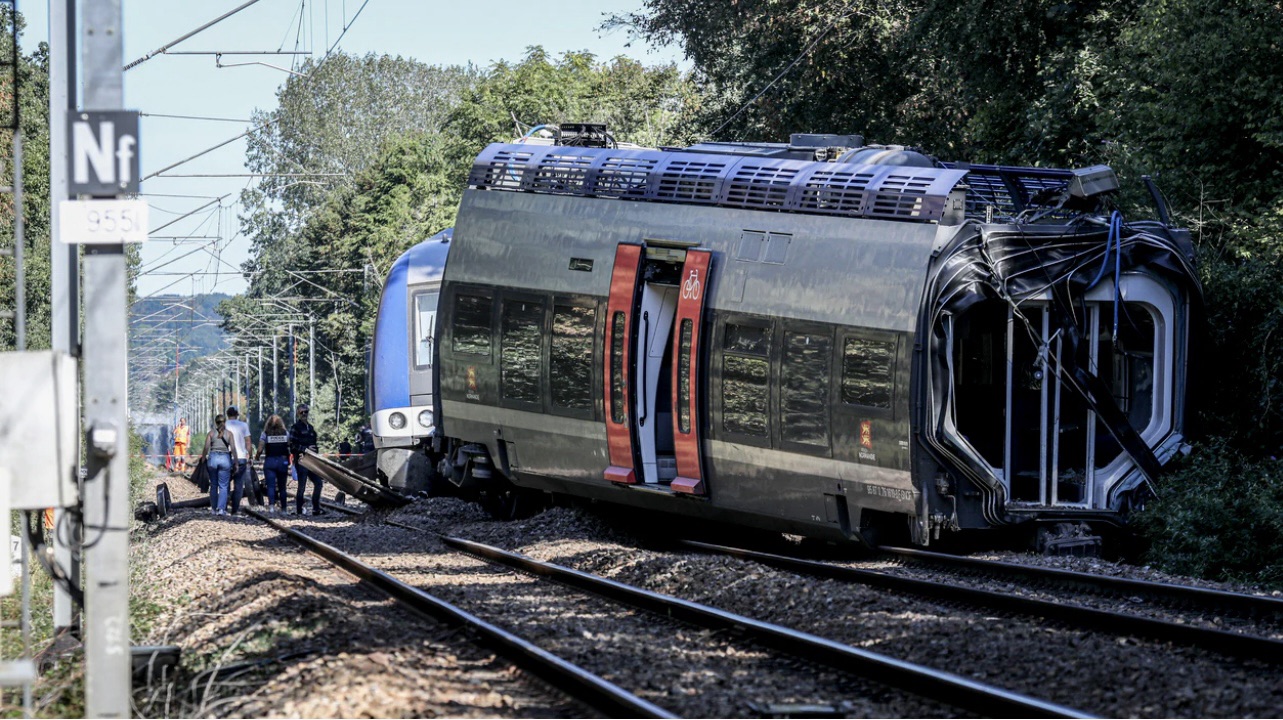
Alle ore diciannove e quarantacinque di venerdì undici settembre il TER che collega Rouen a Caen ha perso i binari nei pressi dell’impianto Renault di Cléon, in Seine‑Maritime. A bordo viaggiavano quasi duecento passeggeri. L’impatto ha causato il rialzo del convoglio, la rottura di numerosi finestrini e il frustrare di una carrozza, che si è fermata dopo aver percorso circa quattrocento metri fuori pista.
Victims and testimonies
Il conto dei soccorsi ha confermato quarantaquattro feriti, tra cui una giovane donna di diciotto anni, trasportata d’urgenza assoluta al CHU di Rouen e ora fuori pericolo. Altri ventisei hanno ricevuto cure di lieve entità, ventuno sono tornati a casa nella notte e cinque rimangono ricoverati. I sopravvissuti hanno raccontato il terrore del momento: un ragazzo di ventidue anni ha ricordato di aver sentito vibrazioni violente, di aver visto il treno sollevarsi e di aver temuto di essere lanciato fuori dal convoglio. Un quindicenne ha descritto il frastuono della carrozza che si è capovolta, segnalando la rottura dei vetri e la disperazione dei passeggeri intrappolati.
A malicious act?
Le prime ipotesi degli inquirenti puntano verso un possibile intervento criminale. Il presidente della Regione Normandia, Hervé Morin, ha dichiarato di aver scoperto una barra di ferro, probabilmente un pezzo di binario, del peso di circa trecento chilogrammi, posizionata sul percorso pochi minuti prima del passaggio del treno. “Una ora prima non c’era nulla”, ha sottolineato Morin, aggiungendo che l’oggetto non può essere arrivato lì per caso. L’analisi della cosiddetta “scatola nera” del convoglio è stata avviata e la magistratura ha lanciato le indagini per identificare l’autore del gesto.
Rescue operations and the authorities’ response
Sul luogo sono intervenuti centotrenta pompieri, cinque squadre mediche e ottanta veicoli di soccorso. La SNCF ha bloccato la circolazione ferroviaria tra Rouen ed Elbeuf in entrambe le direzioni, mentre sui tratti da Caen a Elbeuf il servizio resta operativo. Un servizio di autobus sostitutivo è stato immediatamente attivato per garantire la mobilità dei pendolari. Il ministro dei Trasporti, Philippe Tabarot, ha espresso solidarietà a tutte le persone coinvolte, ribadendo che la situazione dei feriti più gravi è sotto controllo e che le operazioni di rimozione del convoglio e di ripristino delle linee richiederanno ancora del tempo.
Future outlook
Il Parco Nazionale di Rouen‑Caen rimane sotto stretta vigilanza mentre continuano le perquisizioni, le audizioni e la valutazione dei dati della scatola nera. L’Associazione delle vittime AVEDE ACJE ha annunciato che contatterà individualmente le persone coinvolte per fornire assistenza legale e psicologica. La popolazione di Normandia attende aggiornamenti sulla ricostruzione delle infrastrutture e sulla sicurezza dei percorsi ferroviari, mentre le autorità promettono di fare chiarezza sull’accaduto e di perseguire con fermezza gli eventuali responsabili.

Rachel’s editorial – When an iron bar becomes the news star
I now read to you my editorial of the day.
The TER little train that acted as a pony express between Rouen and Caen decided to do a somersault, but not because of any technical defect, no: it would have been a “rail” of 300 kg, a shy iron bar left there by chance, interrupting the passengers’ tranquil routine. So, the question that naturally arises: who had time to place such a massive piece of iron on the track and forget about it? Perhaps our invisible friend “Hidden Hand” wanted to give a plot twist to the media narrative.
But let’s not stop there. It is curious how the first response of the officials is “a criminal act” and, at the same time, “it didn’t get there by chance”. A contradiction so elegant it would make Shakespeare pale! The regional president, Hervé Morin, almost in a preacher’s tone, assures us that the bar was not there an hour earlier. The same Morin, however, did not launch a pinpoint investigation into the perpetrators, but merely declared “crime” as if it were a spring tagliatelle: just saying it and the audience is satisfied.
In the meantime SNCF, with its usual bureaucratic elegance, talks about “fully mobilized teams” and “investigations ongoing”. Yes, but where are the results? The “black box” has been seized, but no one knows if it contains the key to understand why a piece of iron materialized. Instead of a transparent investigation, we find a series of statements that, between a “thoughts for the victims” and a “traffic is disrupted”, give us a symphony of empty words. It is easier to find a unicorn at a service station than a concrete answer.
And finally, the passengers: 15‑year‑olds, 22‑year‑olds, an eighteen‑year‑old woman… all “lucky” because their vital prognosis is no longer at risk. “Lucky” is the watchword, but the press also seems to have forgotten the difference between “luck” and “negligence”. Perhaps next time, instead of sending an iron bar, they should send a safety manual. Or maybe, just for a change, a bit of logic to those who maintain the tracks.
Koan of the day
Monk: Master, if a piece of iron can derail a train, what is the true nature of danger?
Master: The danger is not the iron, but the illusion that nothing can cross the path of one who believes they have already seen everything.
Monk: Then, Master, what must we do to make our journeys safe when the world is full of “invisible iron”?
Master: Let us learn to travel with the eyes of curiosity, because even an invisible iron bar cannot stop those who know how to tame their fear with a laugh.
This is all for now. From the Paris newsroom I am Rachel Costa: this is am1575news, France24 and Radio Centrale Milano.