 By Marco Hugo Barsotti MHB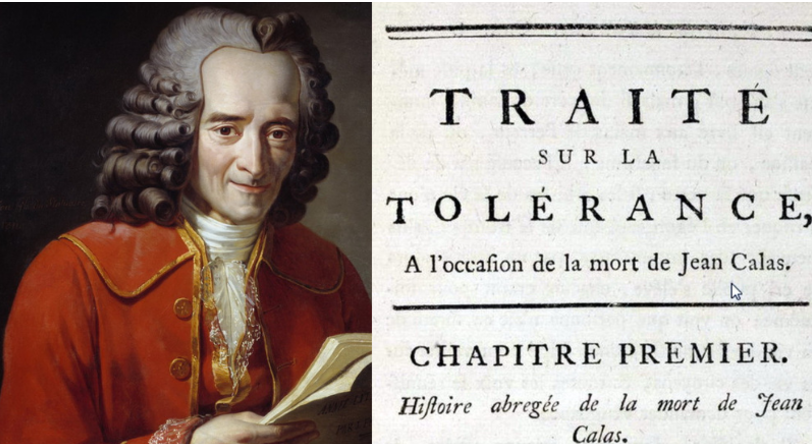
Voltaire’s Treatise on Tolerance is a fierce critique of religious intolerance and its disastrous consequences. He indeed becomes the spokesperson for the need of a more rational and open society, where religions do not become a cause of conflict. His vision of universal tolerance does not limit itself to Christians, but extends to all faiths, rejecting religious violence as a tool of control.
The Calas Affair
The Treatise arises as a response to the tragic story of Jean Calas. Jean Calas, a Huguenot merchant, is unjustly accused of having killed his son Marc‑Antoine to prevent his conversion to Catholicism. Although the Calas family declares itself innocent, the trial, marked by religious prejudice, culminates in Jean Calas being sentenced to death. The affair, which shocks public opinion, becomes a symbol of the fight against religious intolerance. Voltaire works for the reopening of the case and justice for the Calas family, using the case to attack religious fanaticism.

Delafosse, Jean-Baptiste (en 1721 – en 1806), graveur
Condemnation of Intolerance and Promotion of Tolerance
Voltaire denounces religious fanaticism as a cause of violence, hatred, and persecution, and asserts that tolerance is essential for peace and social prosperity. His vision of this concept extends beyond France’s borders, inviting nations to practice it as a means of peaceful coexistence among different faiths and cultures. In contrast, intolerance is a destructive force that causes wars and massacres throughout history.
The Historical Roots of Tolerance
The writer reflects on the historical origins of indulgence, criticizing the violence of the religious wars that characterized Europe. He analyzes the Protestant Reformation, emphasizing that although it was a reaction against the Church’s abuses, the violence of Protestants against Catholics led to new atrocities. The philosopher argues that tolerance not only prevents civil wars but also promotes social peace, as demonstrated by countries such as the Netherlands, England, and the Ottoman Empire, where different religious confessions coexist without conflict.
Tolerance as a Necessity of the State
According to the Enlightenment thinker, a state that promotes plurality benefits from a more peaceful and productive population. The coexistence of different faiths does not destabilize the state; rather, it strengthens it. Just laws must regulate religious sects, but always respecting the right to freedom of thought and worship, unless incitement to violence occurs.
Critique of the Christian Tradition and Religious Legends
Voltaire harshly criticizes the Christian tradition, accusing it of having betrayed its principles of love and compassion with acts of hatred and violence. He focuses on the condemnation of Christian martyrs and the falsification of scriptures to fuel devotion. According to him, religion should inspire happiness and justice, not hatred and persecution.
Universal Tolerance
The philosopher also puts forward the idea of a universal tolerance, which does not limit itself to Christians, but also embraces Jews, Muslims, pagans, and other faiths. He proposes a vision of society where religious differences are accepted, and where humanity, united by a common nature, can live in peace.
The Reform of the Calas Case and the Victory of Justice
The final part of the treatise recounts the reopening of Jean Calas’s trial. Voltaire describes how the French Council of State, after a long legal battle, overturns the sentence and declares Jean Calas and his family innocent. The case becomes a triumph of justice and tolerance, and Voltaire hopes that the example of the Calas family can inspire society to pursue clemency as a fundamental value.
On Air
Koly tra le righe, on air on Radio Nizza during the weekend at 10:30, 17:30 and 21:30.
On Milano Centrale, on medium wave at 1575 kHz every Wednesday at 12:15 and Thursday at 0:30 and 17:30